

Somewhere tonight a fifteen-year-old, without quite realizing it, is deciding who to become. He has more capability within reach than anyone in history: a research lab in his pocket, a tutor that never sleeps, a film studio, a printing press, and a bank. What he doesn’t have is the implicit answer to the only question that matters at fifteen. Not what can I do, but who should I be. And too often the only “adult” in the room is the social media feed. I watched a child face that question years ago. For these next four essays, I will call him Max.1
Our society (driven mechanistically via the social media feed) has its answer ready. It has two, in fact, and it will assign his by zipcode and household income. I’ll show you them shortly. But first I want to explain why this is so important.
Every kid needs someone to become
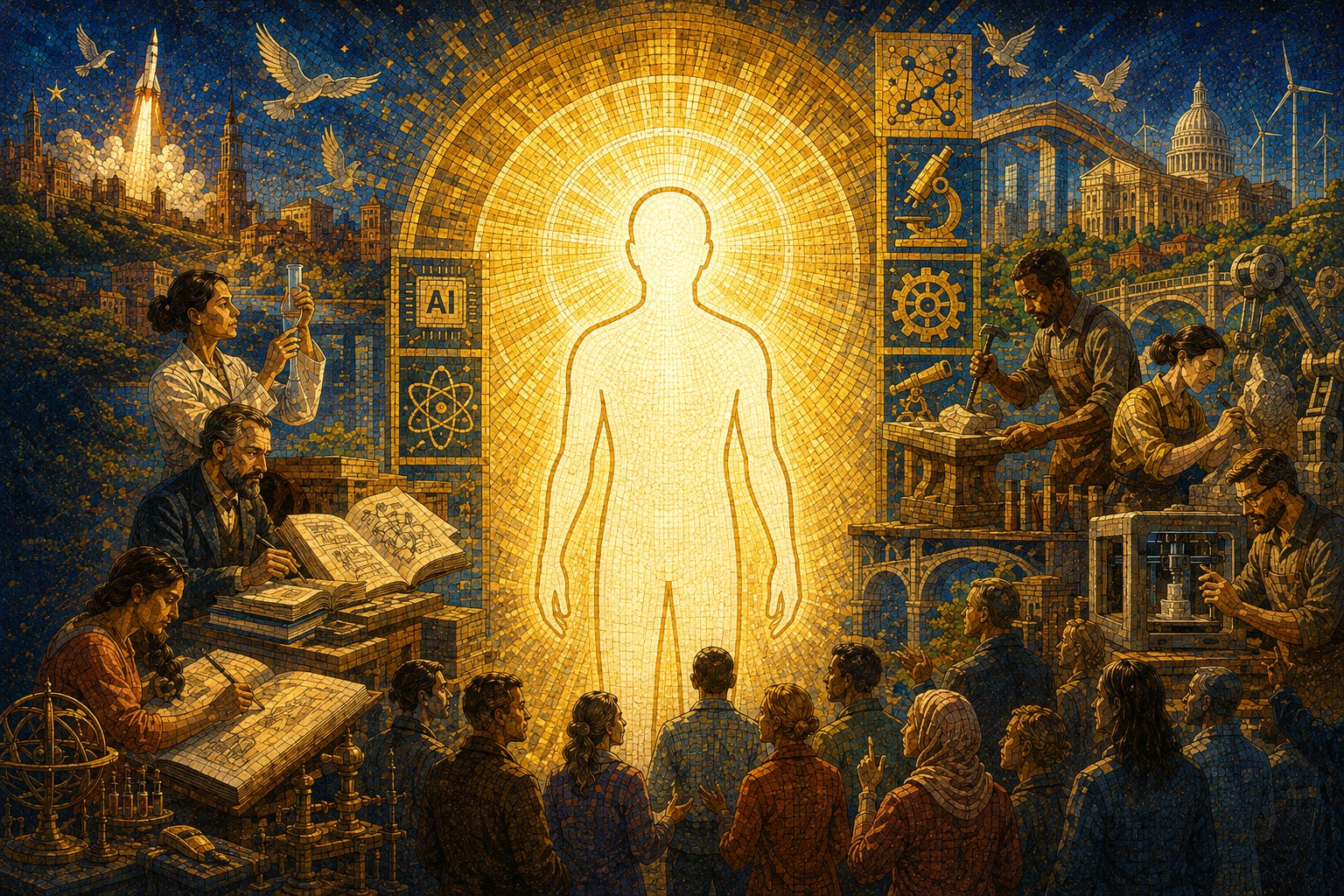
Civilizations have faced this before, and I traced the pattern in The Fourth Pillar: at every great transition, the lasting answer was a new definition of the ideal person. Florence had the uomo universale, the person whose powers could be cultivated in many directions; its how-to manual, Castiglione’s Courtier, ran through something like sixty printings in a century2. Those portraits were imperfect, sometimes disastrously so. Yet they still did a job no institution has kept whole since: they gave a fifteen-year-old someone to imitate, a school a person to form3, and a patron a reason to fund work whose return would arrive in human beings rather than cash. The next Renaissance is missing its model person.
The vacancy would matter less if the kids were inheriting ordinary tools. They’re most certainly not. AI is taking powers that used to live inside institutions and handing them to individuals: the capacity of a laboratory, a media operation, a private tutor, a sales force, or even sometimes a political campaign. When the power leaves the institution, so does the responsibility, creating this vacuum.
AI makes this urgent because it weakens the old defenses of human dignity all at once4. The old defenses were reasoning, making, and knowing, and the machine now does all three on command. The standard response is to run faster. That protects a career for a while. It does nothing for the fifteen-year-old, who is not defending a career. He is implicitly assembling a self.
Here’s the part that should make us optimistic: this has happened before, many times. Every renaissance says being human is what the machine can’t do. The printing press reproduced text but not judgment, and humanism answered with judgment, taste, and eloquence. Steam produced power but not meaning, and the Romantics answered with nature, feeling, and craft. Mass production filled the house with goods and made getting them ordinary, and the postwar world answered with authenticity.
The machine’s weakness becomes the age’s conceptualization of the ideal person.5 So, what does that leave us today? AI can produce content. It cannot be present for a dying parent, keep faith with a town, raise a child, restore a house, or make a judgment that will cost it something. It cannot belong, and it owes you nothing once the conversation ends. And most of all, it can’t tell us what it is to be human, can’t say which science questions fascinate us or what moves us or what meaning we should find in life; that will be the ultimate inexorable role for us.
The feed is raising two kinds of people
If we don’t take action, our kids will be shunted to one of two archetypes.
For the capable few, the default is the free agent: intelligent, portable, personally branded, with machines running the errands, and careful never to acquire an obligation that limits optionality. That person will be even more capable. With every day, I’m less and less sure they’ll be free.
What that portrait lacks is beneficiaries: people whose interests place a claim on what the free agent can do. A life with no binding obligation looks open from the inside and strangely easy to manage from the outside; the worker becomes a subscription customer, the citizen an audience segment, the friend a contact who can be muted. The model isn’t evil. It’s just too thin, too limited to carry a civilization.
For everyone else there is a managed counterpart,6 the permanent client. Sickcare manages conditions it does not cure, schooling certifies without examining what it forms (a failure that runs all the way up: I was a professor, and I know what grad school forms by accident), the spiritual marketplace consoles without transforming, and each teaches the same lesson daily: your deficits are permanent, and the fix is rented, never owned, never finished. The problem with the client is not needing help. It is being kept from needing less, because the needing is somebody else’s business model.
This system is very stable since these two archetypes are self-reinforcing. The free agent learns to run the extraction economy, the client learns to feed it, with both inevitably depending on each other while viewing the other as the enemy, the true villain ruining society. Neither default is a person you’d choose for your kid the day they’re born. Both are what happens when nobody chooses. And the feed isn’t the only room nobody answers for. A home has defaults too, and a bad one shows up in the kid a decade later.
The missing archetype is someone you could feel comfortable handing them power. For example, a trustee holds something that matters for people who are counting on them7, and accepts the duties that come with it. The word comes from law and boardrooms; it’s about to be needed in ordinary life.
The third portrait is the Trusted Builder
The third portrait begins exactly where the machine stops: presence, craft, place, and judgment that costs something to give, and it is nobody’s default. To be clear about what formation can and can’t do: nobody chooses a kid’s starting material, and much of it is fixed (nurture is clearly important, but a lot may be fixed by nature). A portrait doesn’t rewrite nature. It decides what the nature meets, what’s possible from there.
I’ve started calling that third person the Trusted Builder, and not because everyone should start a company8 (as much as I’ve championed that). A teacher, parent, nurse, machinist, scientist, minister, investor, or writer can be a Builder. The common feature is that they hold responsibility for something real and use their capability to leave other people more capable. A builder creates capacity. A trustee remembers whom that capacity is for. The Trusted Builder is both.
Both halves matter, because trusteeship turns into a flattering identity fast9. The person who says I hold this for others may be the person least able to see whom the holding really serves, so the portrait needs more than conscience: it needs evidence capable of defeating the preferred story, and people with enough standing to contradict its holder. My last trilogy, The Counterfeit Hero, ended exactly there: the best-designed game is close to necessary and nowhere near sufficient10, because the game cannot supply its own keeper: the person who holds what is true above what they want.
I don’t profess that my outline here of the Trusted Builder is the final answer. We still need to answer key missing questions like what does this person do with money, power, failure, family, and time? Who can contradict them without losing their place? A model person is a character in a story, not a list of traits, and the character is still being drawn. It has to be drawn quickly. Max was nineteen before the adults in his life finished arguing about the curriculum. Formation did not wait.
A renaissance is how you save them
The new portrait of the ideal person needs machinery to support it: earlier portraits came with stories, rituals, schools, mentors, confession, and correction, installed until the model felt like common sense. The oldest integrated version is the next essay’s subject. And it needs a decision, because none of this happens by default; that is the third essay’s business: what it takes to create people we can trust with power.
Back to tonight’s fifteen-year-old, still deciding. Left to himself, he gets the feed’s default by Friday. The alternative has been built before, by ordinary and unsentimental people: Castiglione wrote the portrait, schools trained to it, patrons paid for it, and the result got remembered as a golden age. This problem can’t be handled kid by kid. To solve the problem, we need to make it bigger, at a civilizational scale, with a Renaissance being the most natural consequential outcome.
But a renaissance is not a mood. It is what a civilization looks like when it decides who its children should become, on purpose. Your kids will be powerful either way. Who they become is the part we still get to build.
The machinery we need has a name11, and it’s the last one you’d expect from a scientist. Next week I’ll lay it out.
The Person After AI Series continues next week.
Acknowledgements: Thanks to Ernest Morrow for his discussions that led to the initial ideas for this post. And to Greg Bowman and Lara Pande for their critical reading of this manuscript.
Max. The name is invented and identifying details are changed. The person is real.
The historical portraits. The sequence follows the framework developed in The Fourth Pillar: the scholastic master, the Renaissance person, the self-made man, the Romantic craftsman, the universal worker, the gentleman-professional, and the postwar self-actualizer. Useful primary and secondary sources include Baldassare Castiglione, The Book of the Courtier; Samuel Smiles, Self-Help; John Ruskin and William Morris on craft; and Abraham Maslow on self-actualization. These portraits were never universal descriptions of their societies. They were influential ideals promoted through books, schools, institutions, and art. Peter Burke’s The Fortunes of the Courtier documents the book’s printing history and European reach; the printing figure in the body follows his census of sixteenth-century editions.
How portraits form people. The claim that a model person does civilizational work rests on a documented learning bias: people preferentially imitate the prestigious. Joseph Henrich and Francisco Gil-White describe prestige as an evolved shortcut for choosing whom to copy; Albert Bandura’s social-learning research shows how modeled conduct transmits; Anne Colby and William Damon’s Some Do Care studies how moral exemplars organize an admirer’s development. A portrait concentrates that imitation on a chosen target. The mechanism is real but not sufficient: portraits compete with whatever the surrounding Status Market actually rewards, which is the subject of The Counterfeit Hero.
AI and dignity. The claim is not that machines literally possess every form of intelligence or creativity. It is that AI weakens several familiar claims to unique human value at once. The proposed answer, presence, care, place, trusteeship, and judgment with stakes, is a normative argument rather than a psychological scale.
What would count against the elevation pattern. Three cases make an induction, not a law. The pattern fails if the age’s portrait forms around what the machine does supply: if the next decade’s admired person is the best prompt-writer, this essay was wrong about where dignity relocates. The pairings are also loose in time: humanism predates the press by a century, and printing spread it more than it sparked it. Read the pattern as recurrence, not clockwork.
The two defaults. The permanent client extends the Gatekeeper Economy argument (see “To Solve It, Make the Problem Bigger”) from business model to formation: what the gates farm, they also form. The full argument arrives in a later essay.
Trusteeship and devolved capability. A trustee holds property or authority for beneficiaries and accepts duties of care, loyalty, and good faith. The extension from institutional trusteeship to individuals with consequential capability is informed by Aaron M. Renn, “The Public Intellectuals America Needs” (2026), which argues that declining institutional trust increasingly places institutional responsibilities on selected individuals. This essay generalizes the point beyond public intellectuals to founders, teachers, clinicians, investors, citizens, and others whose tools now carry institutional-scale power.
The Trusted Builder. The Trusted Builder is the model person proposed across these essays, not an occupational category. The term includes people who form, repair, teach, care, govern, discover, create, invest, and transmit, whether or not they found companies or own financial assets. Trusteeship is not a separate profession; it is the ethic governing what a Builder holds.
Self-deception and correction. The claim that trusteeship needs both inner conscience and external correction draws on Albert Bandura’s moral-disengagement framework, Celia Moore and colleagues’ organizational studies, Emily Grijalva and colleagues’ meta-analysis of narcissism and leadership, and Mark Leary and colleagues’ work on intellectual humility. These sources describe how people can redescribe harmful conduct while preserving a moral self-image, how narcissistic confidence can aid leadership emergence without improving effectiveness, and how recognition that one’s beliefs may be wrong relates to openness and lower dogmatism. The essay’s conclusion is normative: a person trusted with consequential capability should build in evidence and people capable of defeating a flattering account of its use.
The position this trilogy declines, named. The strongest modern statement of it is Yanis Varoufakis’s Technofeudalism: What Killed Capitalism (2023), which designs a complete successor system, share structures, monetary rails, land auctions, citizen juries, and sets itself one rule at the outset: not to “populate my alternative system with people better, smarter or nicer than the ones we meet down the pub.” That is the previous trilogy’s thesis carried to its limit, and I agree with it up to the last step. A better game is necessary. The reason this trilogy exists is that his design contains exactly one sentence about who the people inside it are: “Human nature always finds ways of messing up even the best of systems.”
The single line. Read in order, the three trilogies are one story. The Oldest Solution found the practice of asking something wiser than the planning self and testing what comes back. The Counterfeit Hero showed what a person becomes when that line goes dead. This trilogy is about the person who keeps it open.