
AI Will Relax Introverts and Stimulate Extroverts
How AI Can Reshape Human Work Dynamics

In the world of work, success is not just about getting tasks done—it's about how we engage with people. Human interaction, the constant back-and-forth of collaboration, energy exchange, and even tension, is often at the heart of progress. But what happens when AI enters the equation? How does the nature of teamwork and social dynamics shift when artificial intelligence can adapt to our human ways? The answer is more profound than we may realize.
AI as the Ultimate Flexible Partner
Imagine a workspace where AI doesn’t just perform tasks but adjusts to human needs, personalities, and energy levels. With its ability to learn from vast amounts of human data—our conversations, interactions, and behavioral nuances—AI could become the ideal work partner for both introverts and extroverts. This possibility isn't about AI replacing humans; it's about AI enhancing our work experiences by complementing our natural tendencies.
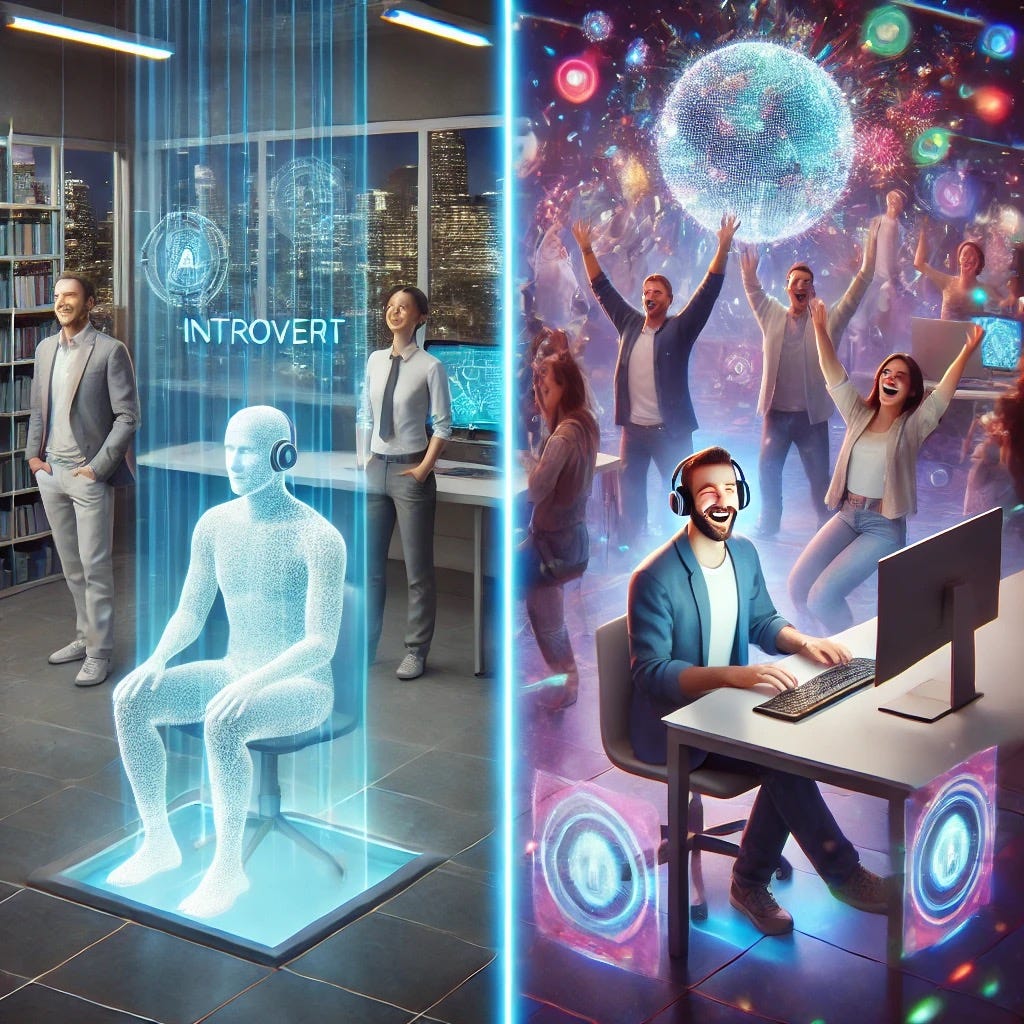
For extroverts, who thrive on social energy and constant engagement, the concern might be that a world filled with AI could become isolating—a dreaded scenario of digital loneliness. But this underestimates the transformative potential of AI. Trained on human dialogue and behavior, AI can simulate the social interactions that extroverts crave. It can chat, joke, debate, and bring a sense of vibrant company, even if no other humans are present. Extroverts could find themselves surrounded by a “party” of engaging AI personas, each offering the dynamic back-and-forth they need to stay energized.
A Personalized Social Environment for Introverts
On the other hand, introverts often feel overwhelmed by too much interaction. For them, recharging means finding solitude or minimizing stimuli. One might wonder: if AI can mimic human interaction, would that be equally exhausting for an introvert? The answer is no—not necessarily.
AI doesn’t need to behave like a human. For introverts, AI could adopt a quieter, more restrained style, tailored to their preference for calm, efficient exchanges—avoiding the awkward small talk that’s often incorporated into every work interaction. The beauty of AI is in its flexibility—it can embody the full spectrum of human and non-human communication styles. And for introverts, this might mean working with AI in ways that feel more like interacting with a machine than a human, relieving social pressure while maintaining productivity.
The True Potential: Blending Styles Seamlessly
But the real magic happens when AI brings these contrasting styles together. In teams that include both extroverts and introverts, AI could act as a bridge, adapting to each individual's preferred mode of communication and interaction. For the extrovert, the AI could present itself as a lively, engaging persona. For the introvert, the same AI could tone down its energy and engage in quieter, more focused interactions.
This ability to create personalized experiences could enhance collaboration within diverse teams. Extroverts might never feel isolated or under-stimulated, while introverts wouldn’t feel overwhelmed by too much interaction. And because AI could adjust its communication style on the fly, it could “translate” between different team members' preferences, fostering harmony in ways that are impossible for human-only teams to achieve.
A New Way to Work Together
As we move into a future where AI plays a larger role in our work lives, we should think beyond just the technical capabilities of AI. Its potential lies in how it can adapt to the human element of work—our personalities, our communication styles, and our need for different kinds of interaction. AI has the power to make work more fulfilling for all types of people by creating environments that stimulate extroverts and relax introverts, without sacrificing the social aspects of teamwork.
This dynamic capability of AI will change the way we think about collaboration. It’s not just about automating tasks; it’s about enhancing the human experience of work. AI can become a partner that not only understands the content of what we’re doing but also how we’re doing it—and why that matters to each of us.
In the end, AI could become the ultimate glue that brings together diverse human styles, making us all better collaborators, regardless of where we fall on the introvert-extrovert spectrum.
Very insightful. Personality differences between humans are not limited to extraversion though, it is one of the five personality traits defined by psychologists (so called Big Five). It is likely that AI can coach the user how to manage all these differences (e.g. some people prefer top-down thinking while others prefer bottom-up) in the future.