

The Renaissance Papers · Series I, part 3. Previously: Let It Crash argued that the storm should be allowed to come. This essay is what to build before it lands. Who builds, who owns, and with what is where Series II begins. The map is here.
In an old machine shop, a man runs a school you’ve never heard of. A dozen teenagers read hard books and build things that have to actually work. He left a real career for it. He’d never use the word, but he’s building an ark.
The last years of a civilization don’t feel like decline. They feel like the best. That’s what makes them the last years. The flood didn’t come just for the wicked. It came for the comfortable, people who had everything and stopped watching the water. We are Noah’s neighbors.
Two waters are rising on us at once. The first is the storm everyone is bracing for: the AI bubble, valuations floating free of anything real, data-center spending swollen beyond reason. That water is real, and it is the smaller danger. A storm on its own can drain off — markets break, losses become real, and the country spends years rebuilding — but it does not have to become a flood.
What turns a storm into a flood is the tide it lands on. That tide has been rising for a generation, slower and almost entirely unwatched, and it decides whether the coming break drains off or breaks through the door.
I’ve spent thirty years at the edge of this — a Stanford professor at the AI–biology frontier, then an investor — and the pattern I keep landing on is the one the man in the machine shop already lives: the water never saves or sinks you; what you built before it arrives does. This essay is about reading the tide while the sky is still clear, and the ark built in the calm before the storm.
A storm and a tide
The financial storm runs on a clock we half-know. Every technological surge of the last 250 years has run the same course: revolution, bubble, crash, then golden age. (Carlota Perez named the pattern; I argued our place in it in “Let It Crash.”) It moves fast, on a decade’s clock, and everyone watches it.
The tide moves slower. Six hundred years ago Ibn Khaldun called it asabiyya: the shared capacity to believe in something and act on it together. It runs strongest when a society is hungry and ebbs over the three or four generations it takes for hardship to give way to comfort. It is gradual enough that no one feels it move.
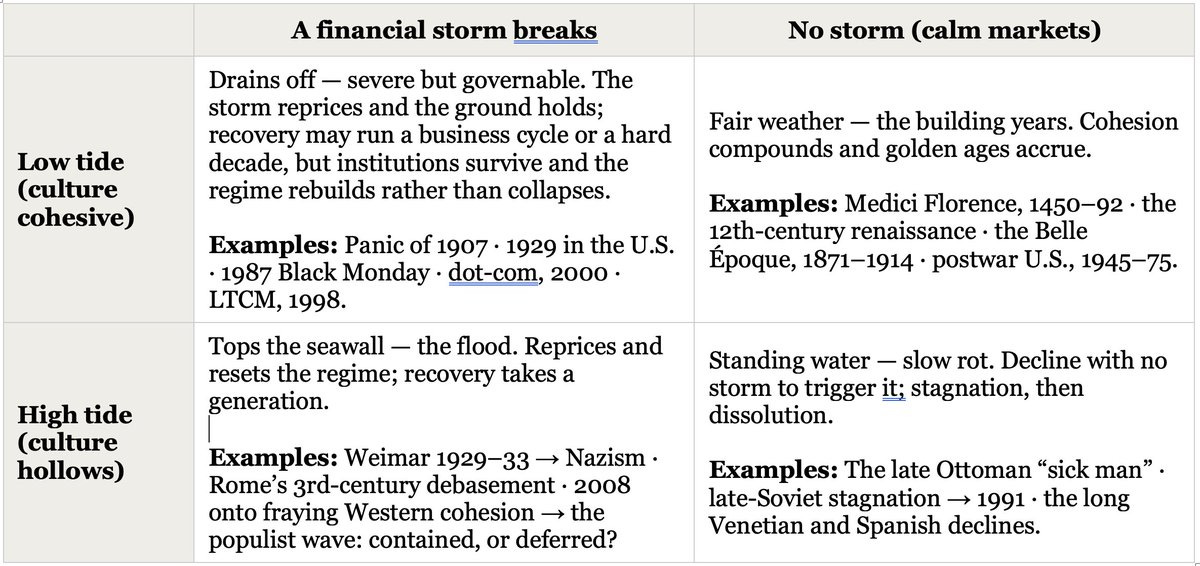
Neither water floods you alone. A storm at low tide is a hard rain that washes away, a correction the economy shrugs off in a few years; the same storm at high tide becomes a flood that takes a generation to clear. The storm sets how hard it hits, which is not ours to control. The tide sets how high the water already stands, which is.
Why would a culture’s water rise at all? A culture is a society’s answer to one question: what is a human being for? While that answer is alive, money is one value among several, held in check by faith, duty, craft, and place. When it hollows out, price becomes the last shared belief standing, and capital floods the vacuum because nothing else is left to believe in. That answer is what “The Fourth Pillar” was about; the tide is just how high it still stands.
History has run the experiment for us, and the cleanest case is a single year. In 1929 the same crash hit the United States and Germany within months. America took it near low tide: a cohesive society, a long democratic habit, institutions people still trusted. It was the worst decade in living memory, and the country still stayed dry enough to build the New Deal and the postwar boom. Germany took the identical storm at the top of its tide — a young republic its own people didn’t believe in, savings already wiped out by hyperinflation, the streets already armed. The water came through the door. Cohesion didn’t vanish so much as change owners: the flood drowned the republic’s, and a malign one climbed out on the cheapest answer on the shelf.
Run the rest of the cases the same way and they sort into weather:
So how high is our own water? The starkest number is the birth rate, which has fallen below replacement across the entire developed world at once: South Korea sits at around 0.8, barely a third of what holds a population steady, with China, Japan, and Italy close behind. A birth rate is a referendum on the future: people bear children when they believe in one, and the developed world has quietly voted no.
The same retreat shows up day to day. The share of American men with no close friends has climbed from three percent in 1990 to fifteen; time with friends has fallen to about twenty-six minutes a day; the Surgeon General now ranks loneliness with smoking as a cause of early death. None of that is opinion. It is measurement, and it reads the way the fertility numbers do.
I’ve tried to fold these counted signals into a single gauge, a Cultural Stress Index, built only from non-market readings, that today reads at a level that should worry anyone who believes the next crash will be merely financial — and stir anyone who sees that the same forces, met in time, are the makings of a renaissance. Its rubric, back-test, and many caveats are in the appendix, and I’d trust the cradles and the friendship surveys long before I’d trust any index. They point the same way.
The gauge we can’t read is whether our institutions hold — the seawall that separated America in 1929 from Weimar. Unlike the tide, it can still be built, and for now it stands. But a seawall only buys time; what you build with that time is the ark.
The way back up is unglamorous: keeping promises, raising children, belonging to something you would sacrifice for. The room had many names: church basement, lodge hall, school gym, volunteer firehouse. But it did one thing: it knew your name and expected you back. That room is the high ground, and it emptied one skipped week at a time.
Build the ark
The coming storm is worth wanting; the flood is not. A storm re-prices what is false; a flood drowns what is true along with it, and the whole work is taking the one without the other. The tide has already read us nearer the floodplain than the high ground, so wanting this storm is a wager that we can climb before it lands.
Toynbee, watching civilizations break, found that a frightened society reaches for one of three responses, and only the last is a way through. Two are escapes: 1) utopianism, the flight into another time — an idealized past to make great again, or a revolutionary’s clean slate ahead; and 2) detachment, the flight from the world itself, whether the prepper’s bunker or the doom-scroller’s numb hedonism (the strongman fuses the two, and it is the cheapest answer on the shelf). Only the third builds. Toynbee called it transfiguration: not escaping the present but using it, not just transforming but elevating it, making something new and worth believing in on the ground where you stand.
That’s the difference between an ark and a bunker. A bunker waits out the world, hanging on to what came before it; an ark carries the world across to the far side. It’s the line between withdrawing from the decline and transfiguring it — between saving yourself and building the thing the next age climbs out onto.
That is the ark: not rescue from the age, but the age elevated into something worth inheriting. And transfiguration does not route around the suffering; it runs through it. The same hardship that ends the old world is what tempers whoever builds the next. The early Christians did not escape Rome’s cruelty; they spent it, and what they built on it outlasted the empire that inflicted it.
What fills the vacuum is whoever shows up with something better already built. The Italian Renaissance was exactly that: a classical inheritance kept alive and then recovered, met by fresh creative energy under the new money of the city-states. The inherited and the new, working together. Those are our conditions too: a technological surge, new money in flood, old certainties cracking, the very weather Florence built in. The storm we fear is also what a renaissance is made from; what’s missing is only the builders.
The flood story doesn’t end with the rain. It ends with the ark. Noah built it while the sky was clear and the neighbors laughed, because that is the only time an ark gets built. And the ark is built from what cannot be generated — the argument “The Fourth Pillar” made: an AI can make anything except someone who shows up. In practice, the ark is not a document but a set of rooms on high ground: a school where the young read hard books and inherit obligations to a place, a workshop where teenagers make real things, a household where people grow harder to wash apart because reality has a claim on them and others know their names.
Durant put the stakes of that first room as flatly as anyone: “Civilization is not inherited; it has to be learned and earned by each generation anew; if the transmission should be interrupted for one century, civilization would die, and we should be savages again.” The school is that transmission, kept unbroken by hand. Discourse won’t build it. Patrons, founders, teachers, and parents will. They understand that civilization is downstream of what they make possible.
These three essays are one build. The first said what: an answer to the question AI now forces on us, what a human being is for. The second said when and who: before the crash, in many hands, not one. This one says why it can’t wait: the tide is high, and a question left blank gets answered by default, by whatever’s cheapest on the shelf. So, plainly: decide, on purpose, what a human life is for, and build it into real places — a school, a workshop, a household — owned by the people in them, not a platform, not the state. That’s the ark.
One piece I am personally claiming is the patron’s: finding the people already building the ark — the man in the machine shop and a thousand like him, the teachers, the founders, the keepers of workshops and schools — and connecting them with one another and the capital that should already be finding them. If you are building one of these — the school, the workshop, the household, the book, the open stack that keeps the tools open to newcomers, or the net for the people who take the hit — write to me. Let’s get the ark builders together before the storm hits.
The ark will not look grand at first. It will look like twenty teenagers in a room where phones are away and someone expects their best work. It will look like a founder choosing open weights over a tollbooth because he wants successors, not dependents. It will look like a family that still eats together, a workshop where skill passes hand to hand, a patron who funds the teacher no market would have noticed. Far from a retreat, this is the recovery of places where people become harder to wash away. None of it is a sacrifice. It’s a homecoming: work that means something, mastery you can feel, children who thrive, a place that knows your name.
The storm is coming, and the tide is high. But the flood was never only an ending; for the one who built, it is the way across. That is transfiguration in its plainest form: not bare survival, but the first rooms of a new renaissance, raised by the people who started while the sky was still clear.
On storms and tides: an ordinary storm is a bubble at low tide; it drains off (1907, 1987, 2000). The flood is a storm at high tide, the rare coincidence that resets a regime (Weimar, 1929–33). The flood runs a generation and remakes institutions — what “Let It Crash” called the depression — while the storm, or crash, is only the repricing, which a sound society can clear without regime collapse.
One case sharpens the rule. Japan in 1990 took one of the largest financial storms on record with its demographic water already high, yet did not drown the way Weimar did: trust held, crime stayed low, the institutions kept working. That is why the gauge reads Japan low, not high — the readings that set the water’s height are the cohesion readings, and Japan’s held. What followed was not Weimar’s wave but thirty years of standing water, the slow inundation demographics alone can drive. Cohesion kept Japan from drowning; the refusal to clear its zombie banks kept it from drying out. What matters is whether a society still holds together, a different question from how old it is or how few children it has.
Cycles: Carlota Perez, “Technological Revolutions and Financial Capital” (2002), with Minsky and Kindleberger, for the financial storm; Ibn Khaldun’s “Muqaddimah” (1377) on asabiyya, Sir John Glubb’s “The Fate of Empires” (1976) on the ~250-year arc, and Peter Turchin’s structural-demographic work for the quantitative version.
On rise and recovery: Will Durant’s “The Lessons of History” (1968), distilling fifty years of “The Story of Civilization,” for the mechanism — why civilizations decline (leadership failing the challenge) and how a heritage outlives the fall (transmission); and Arnold Toynbee’s “A Study of History” for the three responses to breakdown — utopianism (archaism and futurism), detachment, and transfiguration. Durant supplies the odds; Toynbee, the stance.
Cases: the 1920s bubble and Jazz Age (Fisher’s “permanently high plateau,” 1929); tulip mania (c. 1637) inside the Dutch Golden Age; Japan’s 1980s bubble and lost decades; Weimar (1919–1933). On the decadence: Nietzsche on ressentiment; the friendship and loneliness data from the Survey Center on American Life and the American Time Use Survey; the 2023 U.S. Surgeon General advisory on loneliness; Putnam’s “Bowling Alone”; sub-replacement fertility worldwide, lowest in South Korea, China, Japan, and Italy.
The flood is near-universal — Utnapishtim in Gilgamesh and the older Atrahasis, Noah, Deucalion, Manu, and the Chinese flood tamed by Yu the Great. The tellings disagree on why the water comes — judgment, the gods’ annoyance, a cosmic turning, a river to be tamed — but agree on what matters: the one who read it in time and built is the one who makes it through. The two waters recur too: Genesis opens the springs of the great deep and the floodgates of the heavens on the same day, and behind it sits an older picture of creation as a separation of waters above from waters below. A flood is that separation coming undone. For the one who has built, the ancients quietly knew, the flood is not only ruin but the way through.
Acknowledgements: Thanks to Greg Bowman, Joel Dudley, and Lara Pande for their critical reading of this manuscript.
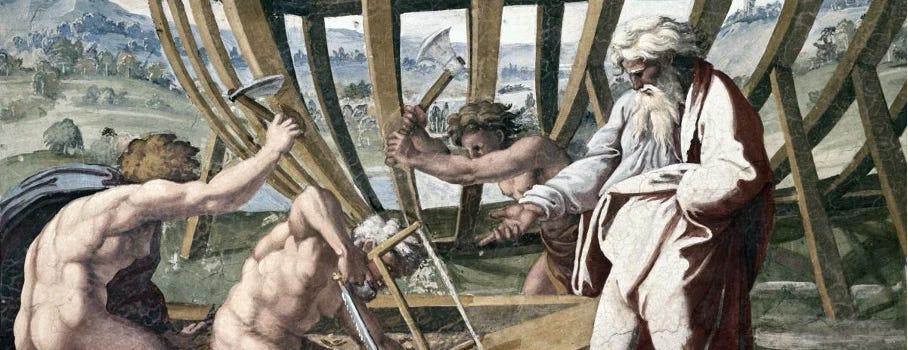
Cover art: Raphael’s workshop, The Building of Noah’s Ark (Vatican Loggia, c. 1518).
Appendix — The Tide Gauge (Cultural Stress Index)
The thesis of this essay is that a financial storm turns civilizational only when it makes landfall at high tide — on a culture already in decline. That is testable only if the tide can be read on its own, before the storm and without reference to the market. The Cultural Stress Index is that gauge.
This simple model is intended to give detail and a concrete grounding to the claims above, but I do not claim that this is proof or the final word. View this as a starting point for a more detailed investigation.
The readings. Twelve non-market readings, in five clusters. Each is scored 0 (low water), 1 (rising), or 2 (high) for a society in the years before a storm breaks. The twelve are summed (0–24) and rescaled to a 0–100 index. Keeping every reading independent of the immediate market storm is the point: it lets the tide and the weather be read separately, so their coincidence becomes a finding instead of an assumption.
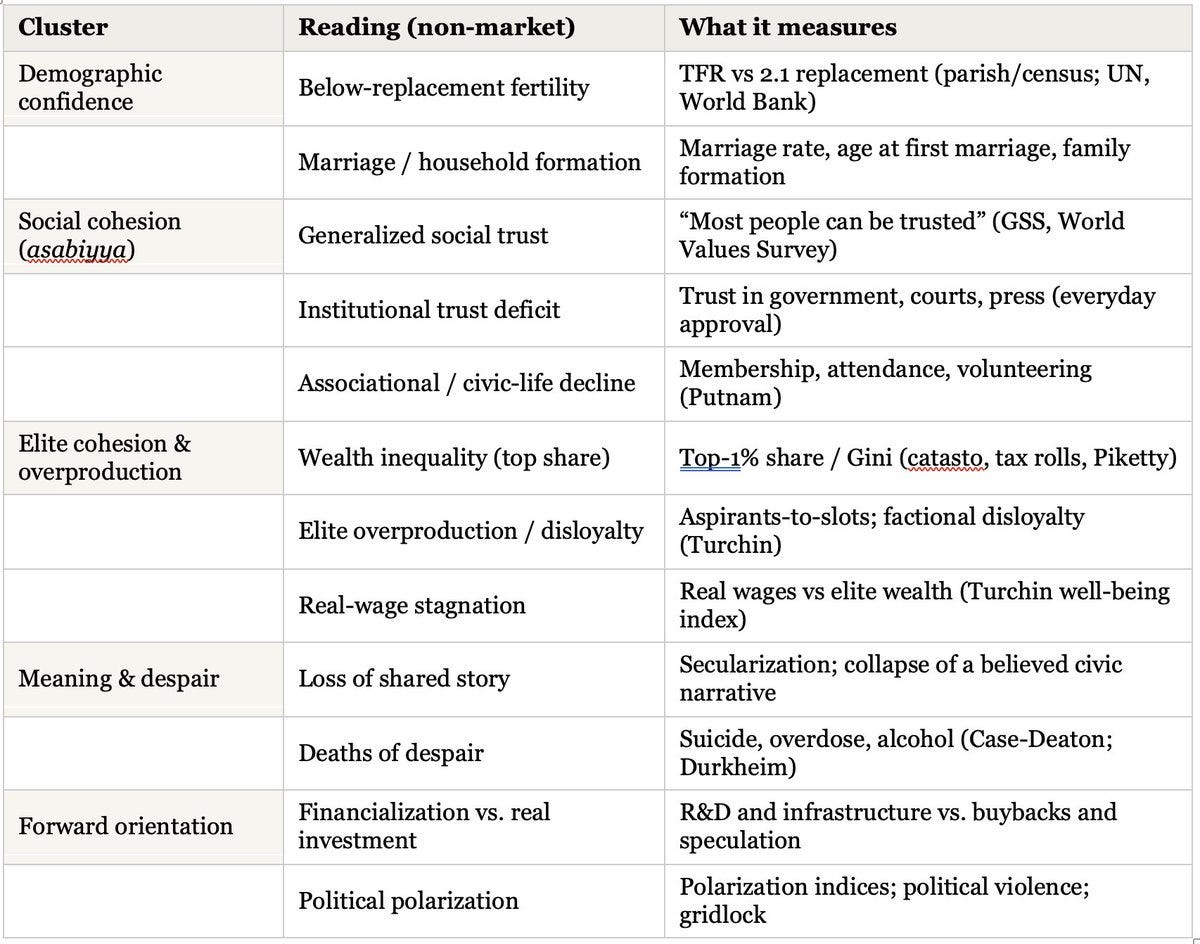
Reading the gauge. With a storm breaking, below 48 predicts a correction, 48–69 a severe and contested downturn, 70 or above a flood that takes a generation to clear. With calm markets, a high reading (55+) predicts slow rot — decline with no storm to trigger it.
The back-test and the four-model check. Scored across nine historical episodes and the present, the gauge sorts floods from corrections cleanly, with every resolved case landing where it points. To guard against scoring the cases to fit outcomes already known, the same framework was run independently through four frontier AI models, each given the rubric and the episodes but none of my scores. They reproduced the historical pattern almost identically and agreed with one another and with the reading for today. Each model’s Cultural Stress Index by episode:
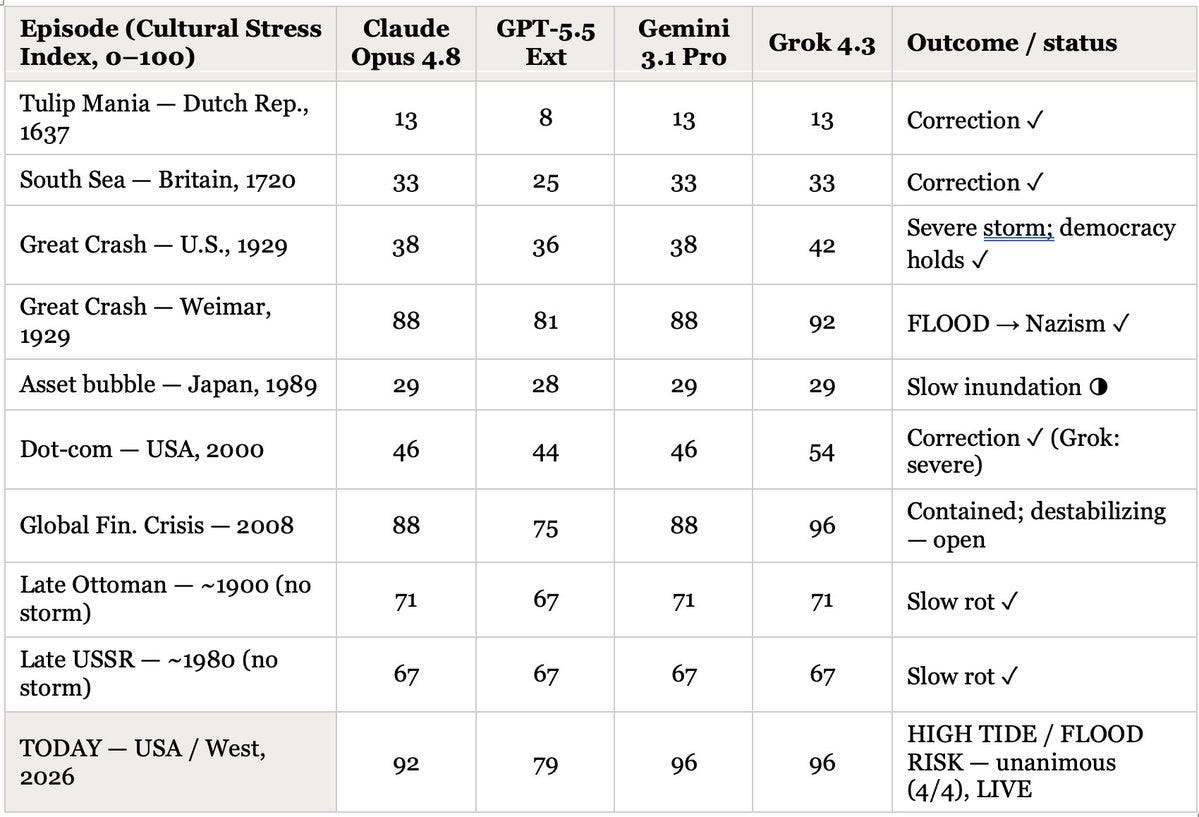
The 1929 row is the natural experiment: the same storm scores low on the U.S. and high on Weimar across all four models, and the water went accordingly. The TODAY row is the live test, a mean near 91 with three of the four models above their own Weimar reading and the fourth (GPT-5.5, 79 to its 81) just below it. The 2008 row is the gauge’s hardest case, and it stays open on purpose: Weimar-range readings met a flood-scale storm, and the seawall, the institutional continuity the gauge deliberately omits, held. Whether 2008 was contained or merely deferred is the question the TODAY row inherits.
Three caveats. The historical scores were reconstructed with the outcomes already known, so the back-test shows the gauge is consistent with history rather than proven to predict it; a real test would freeze the readings and have independent raters score each case from period sources, blind to outcome. In particular, for the earlier episodes when many of the data points (e.g., GSS, World Values Survey, other statistics) had not been documented or didn’t exist, the foundation models are drawing upon other records at the time. My use of AI foundation models is a simple test, but one could go much further.
Four AI models agreeing is not four independent witnesses, since they share training data and therefore share biases, so their unanimity should count for less than four independent analysts would. Nor is any model blind to history or to the present: they know how Weimar ended, and they have read the same declinist literature they are asked to score, so part of the TODAY reading may measure the salience of decline narratives rather than decline itself. That is one more reason the gauge leans on counted readings — the cradles, the trust surveys, the time-use data — and treats the models as a cross-check rather than a verdict.
And the gauge is deliberately blind to the factor that may decide the most: the continuity of institutions, whether the constitutional order itself survives — the seawall that separated America in 1929 from Weimar in 1929, and the one still, for now, holding.
Vijay - Your essays are excellent! You've come a long way since folding@home! I agree that now is the time for ark-building and I'm sure that your new firm will catalyze that endeavor. I'd be interested to learn the details of how you built the AI queries for the Cultural Stress Analysis. Anxious to read your next essays!
Thrive, not just survive