

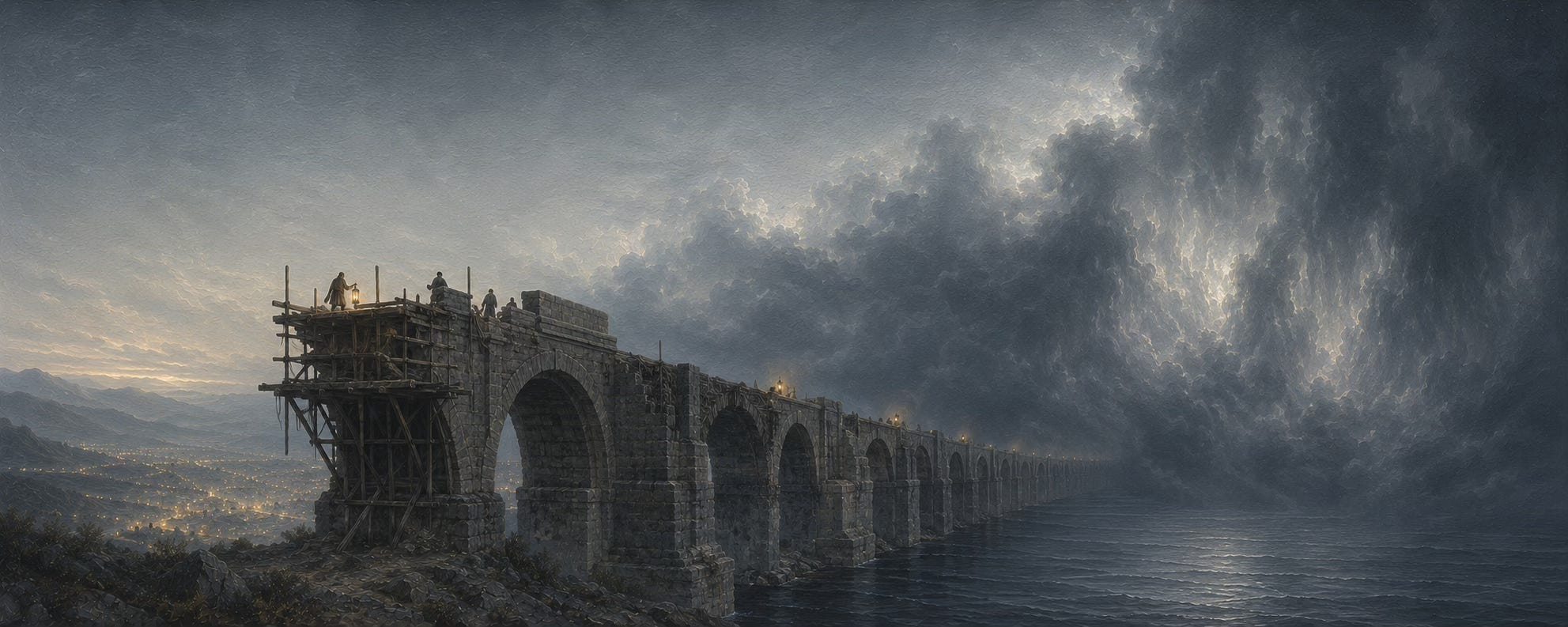
How does humanity learn to solve its greatest problems? There’s no textbook for the unprecedented. And no mentor who’s done it before. And yet history is full of people who did it anyway. Look at how, and the same account repeats.
Noah is told the flood is coming, and to build. Moses turns aside to a bush that won’t stop burning and gets his orders. Jonah runs, ends up in the dark, and finally asks. Arjuna freezes on the battlefield and the god in his chariot tells him what to do. Muhammad in the cave. The Buddha under the tree. Different traditions, different names, different centuries (some cousins, some complete strangers), and the same scene shows up over and over: a person handed a task far bigger than themselves turns toward something larger, asks, comes back with direction, and builds.
This is also the well-known call of the hero’s journey, giving him the task, which sends him seeking the library and the mentor.
But these two questions have answers hiding in plain sight. The textbook for the unprecedented exists — the first “Oldest Solution” essay was about it: myths, humanity’s open-source library of inherited solutions, fifty thousand years of moves that survived, many because they worked. And the mentor exists too — the second essay found it in the wide mode, the mode of mind that answers when you get quiet, the one Jung couldn’t tell apart from God.
Here’s the part that took me longest to see. There is one practice that connects the textbook and the mentor. Talking to God is itself a meme, forked across cultures, transmitted, selected — and what it encodes is the use of the wide mode, the faculty that hears what no archive holds. The library’s deepest entry is the instruction for what to do when the library runs out. The library stores the moves, like a book that teaches chess. Listening helps choose — or, when needed, invent — the one the moment needs.
Two roads to the same practice
Two different investigations keep landing on this same practice. The neurological road, from the last essay: get quiet enough that the narrow, calculating mode stands down, and answers can arrive outside awareness — the wide mode is a source, not an oracle. The memetic road, from the first: forget neurons and ask which practices keep getting rediscovered where reality can punish bad versions — across scripture, prayer, meditation, the vision quest, the recurring instruction is go and ask. Two roads, opposite directions, same instruction. Scientists take that kind of agreement between different methods seriously; the philosopher William Whewell named it consilience almost two centuries ago. The convergence supports trying the practice. It does not certify the sender, or the answer.
The Renaissance ran both moves at once. Florence pulled tested code out of antiquity’s library with one hand (Aristotle through Toledo; the Pantheon’s dome, measured and reused), and with the other it listened — prayed, painted, used imagination, faith, judgment, and craft to decide what to build. Recovery first, invention on top. In programmer parlance: copy paste edit. “The Fourth Pillar“ counts that recovery among the pillars every renaissance stands on. Now AI hands us the largest library ever assembled, with retrieval, recombination, and proposal approaching free. Ours may be the first Renaissance to automate the copy and the paste. The edit is still ours. That makes judgment, listening, and responsibility more important, not less.
Let me be precise about the claim, because most problems never need it. Most problems fall to the library and the grind. The greatest problems are the ones where those are not enough. “To Solve It, Make the Problem Bigger” started with healthcare and enlarged the frame twice: first to the Gatekeeper Economy, then to the work of a Renaissance. It concluded that one should make the problem Renaissance-big, then build the road. This Oldest Question trilogy answers the next question: once the problem is that large, where does the road come from?
Talking to God does not provide every answer. It is the move for generating a candidate when the map runs out. Noah’s boat was library code; floods have precedent. What the asking supplied was when, and the nerve to start.
The method working at civilizational scale
So here is the answer to the question in the title. Humanity solves its greatest problems by running four moves in a loop: learn from the library, listen beyond the planner, test what comes back, and build what survives. It is one of the oldest practices we have — not because every answer is right, but because every generation has needed a way to ask when the map runs out.
Slavery. Mass death. Empire. Segregation. War. If the method sounds too simple for the world’s greatest problems, look at what it has already helped break.
Wilberforce wrote that God had set abolition before him, then spent two decades converting evidence, petitions, boycotts, and votes into a law outlawing the slave trade. Nightingale recorded the day God called her, then counted the bodies and forced military hospitals to reform. Gandhi followed the inner voice, then tested nonviolence campaign by campaign until it became a mass force against empire. King, ready to quit in Montgomery, prayed at his kitchen table, heard “stand up for righteousness,” and went back to the movement that helped break legal segregation. After two world wars, Schuman and Monnet turned the lesson into an institution, pooling coal and steel—the machinery of war—in a system designed to make another Franco-German war materially impossible.
None worked alone. No call completed the journey. It made someone accept the task. Then came evidence, allies, institutions, defeats, and years of work. The source changed. The sequence did not: learn, listen, test, build.
Why it matters right now, and not as a comfort
I’ve spent many essays on one concern. A storm is coming, financial for certain and maybe civilizational, and what decides whether we come through isn’t the storm; it’s what we built before it landed. I called that building the ark: schools, workshops, households that hold, a picture of a human life worth wanting on the far side.
So where do the ark-builders get the blueprint? Not from the planning mind, and not from AI — both are brilliant at how and mute on what for. You get quiet, ask the oldest question (”what am I supposed to do here?“), and listen for the part of you that’s wiser than your plans. Again and again, the ark-builder talks to God first and picks up the hammer second. The inner capacity isn’t a nice-to-have beside the outer work. It’s what the outer work is made of.
Here’s the important guardrail, because history speaks to it too. Every call has a counterfeit. The same archive that holds the arks holds the crusades; people have heard voices, sincerely, telling them to burn things — and, far worse, people. So the wide mode generates; the library vets; reality and people you trust verify. Treat the answer as a hypothesis, not an order. Give another person the standing to tell you that you heard wrong, and distrust any answer that demands secrecy, certainty, cruelty, or irreversible harm. The call creates responsibility, not exemption. It starts the ordeal; it does not end it.
I should declare my interest plainly: my day job is backing founders who take runs at humanity’s biggest problems (it says so on the front door of my fund). This trilogy is the part that doesn’t fit in a pitch deck: where I think the solving begins.
Build the practice, then build the ark
This part took me a long time to see, and it changed how I hold all of this.
A believer reads everything I’ve written and sees a familiar story: God is real, God built us able to hear Him, and the way through the flood is to listen. A materialist reads the same words and sees another: there’s no one out there, and “God” is a name for the oldest, wisest layer of your own mind, and the way through is to learn to use it.
For the practice, the metaphysical question matters less than what you do with the answer. The believer and the materialist begin with the exact same act. Both stop talking, ask the same honest question, and listen for something wiser than themselves. They disagree about the source, not the first move, or the responsibility that follows. You don’t need to settle the metaphysics to use the method.
So, I’ll go first. The most concise way to say what happened to me is that God called me to build an ark. I know how that sounds. A few years ago I would have winced at the sentence myself, and I am still nervous writing it now. If it makes you cringe, take it on the materialist side: the widest, oldest part of me finally said out loud what the rest of me needed to hear. I can’t prove it was more than that. That’s not the point. I’ve stopped needing to. The instruction was the same either way, and so is the work.
Drop the G-word, if it’s in your way. Keep the practice. We are facing some of the greatest problems humanity has ever seen, and a storm is coming. I would rather not meet it alone. Problems of this scale are not beyond us. They are beyond any one of us. The machine makes capability abundant. It does not decide what that capability is for. That part is ours. Come build before the storm lands.
The textbook was always on the shelf. The mentor was always in the room. The hammer is yours. Pick it up and build.
Next Tuesday: what happens when the call is counterfeit? "Why Do the Worst People Keep Winning?", first of a new trilogy, The Counterfeit Hero.
Notes: The call-scene lineages, honestly mapped: Moses, Jonah, and Muhammad share one Abrahamic line; Arjuna and the Buddha share the Indic world; the strangers are elsewhere — vision-quest traditions of the Americas among them. Cousins show the meme survives transmission; strangers show it gets re-derived.
Consilience here supports the practice, not the truth of any particular answer. The neurological and cultural lines are not perfectly independent because both emerge from the same human cognitive architecture, and each is contestable on its own: age alone proves little, and independent recurrence where reality can punish bad versions is the stronger signal. One line shows that answers can arrive outside awareness; the other shows that cultures repeatedly rediscovered and preserved the practice.
On the first line: that answers can arrive outside awareness is the incubation-and-insight finding described in the last essay. John Kounios and Mark Beeman record a burst of right-temporal activity roughly a third of a second before a solver reports the answer, and Ullrich Wagner and colleagues (”Sleep inspires insight,” Nature, 2004) found that sleep between exposure and retest roughly doubled the rate at which subjects discovered a hidden rule. Neither result says anything about a sender. Both support the narrower claim this essay needs: the wide mode delivers candidates the narrow mode did not assemble.
On flood-story independence (the ark cascade), see the note to essay one: the Near East cluster is one lineage; the Americas and Australia are not.
The precedent roster: Wilberforce’s conversion and the Quaker abolition campaign (Adam Hochschild, “Bury the Chains”); Nightingale’s call, dated in her private notes, and her Crimean mortality statistics; Gandhi’s “inner voice” in his own writings; King’s kitchen-table night in his own account (”Stride Toward Freedom”); the Schuman Declaration of 1950. The first four examples begin with the actor’s own account of a call. Schuman and Monnet supply the institutional endpoint: lessons from catastrophe translated into a durable structure for cooperation.
Behind this: the flood and call narratives across traditions (Gilgamesh, Genesis, the Mahabharata, and more). William Whewell on the consilience of inductions, revived in E. O. Wilson’s “Consilience.” My earlier essays “The Hero with a Thousand Solutions,” “How to Talk to God,” and “Build the Ark.”
Acknowledgements: Thanks to Ernest Morrow for his discussions that led to the initial ideas for this post. And to Greg Bowman and Lara Pande for their critical reading of this manuscript.
This is tremendously exciting. I can't wait to go back and read your previous essays, and to hear what you have to say going forward. Hoping I can find a way to participate in building the ark.
I've had several experiences of hearing the call, with extraordinary results. In one case, hearing a voice on a mountaintop - and heeding it - started a process which, twenty years later, resulted in that mountain being saved from logging and converted to a preserved natural recreational area. I just flapped my butterfly wings and set in motion an invisible momentum, a mysterious inevitability. It slowly snowballed as more and more others picked it up and did the increasingly heavy lifting. What I did was take that originating voice seriously.
Yet another thought banger of an essay Vijay!
Curious if you think "talking to God" ought to be more of a memeplex rather than an atomic meme in itself.
May I propose that softening and kernelizing the God archetype will yield a far richer spectrum of such conversations perhaps?
Example:
a) Spiritual empiricism, conversation with nature and the shaman archetype : Leading to the birth of proto-science and bio-discovery of powerful artifacts such as Curare, Ayahuasca etc.
b) Cumulative experimentation archetype : The formulation of Terra preta and the taming of the Amazon rainforests to grow food by indigenous communities through cumulative conversations in tight knit communities
c) Rubber duck archetype : The code-cathedrals of silicon valley were majorly fueled by one-on-one conversations between software developers and a proverbial rubber duck that doesn't really yield to the God essence
e) The Divine Muse archetype: Ramanujan and his dream-state conversations with the Goddess Namagiri Thayar where the Goddess is as much a muse as a source of reverence.