

Second in The Person After AI series, after “AI Will Make Your Kids Powerful. But Who Will They Become?”
Religion is a technology.1 A believer may object that religion is also revelation, worship, covenant, and a relationship with God. I agree. I’m a scientist and an engineer, not a theologian, so the structure is visible either way (a secular person can recognize the machinery while rejecting the theology). A cathedral is more than masonry, but it still has an architecture, and the architecture does real work. I call religion a technology partly because that’s not how people usually think of it (and hence to look at from another point of view), but mostly because a technology is machinery that has been used and can be rebuilt.
And rebuilding it is what this essay is all about. For a civilization, religion is the oldest integrated technology for forming a person: schools do a few pieces of the job, armies a few more, therapy one or two, and only religion ships the whole thing together, replicated across civilizations for millennia2. Call what it forms a person, a character, or a soul; the machinery is the same. The machinery is the part you can engineer. The soul is what forms inside it.
The soul has a parts list
A person is built: your character was assembled while you were busy living, and it can be met and rebuilt on purpose. I call the machinery the Formation Stack, and read it like an engineer3, each layer with a job.
The founders were engineers. By founders I mean the people who built religion’s most durable formation systems, and three of them left blueprints we can still read. Benedict, the sixth-century monk whose Rule organized Western monasticism, wrote seventy-three chapters of specifications: the hours of prayer and sleep, the meals, the discipline procedure, the terms for readmitting someone who left. His system ran production, more or less continuously, for fifteen centuries. Ignatius, the soldier turned founder of the Jesuits, built the Spiritual Exercises as a four-week structured protocol, day by day, with an instructor’s manual. Wesley, whose method gave Methodism its name, ran twelve to a class, weekly, the same examination questions every time. And the pattern is not only Christian: the Buddhist Vinaya, the monastic rulebook, was specifying daily life a thousand years before Benedict, and every durable tradition keeps a manual of its own. These are not sermons about formation. They are build documents, and they’re still on the shelf.
Open any of them and the same layers appear. The portrait sits on top: the saint, sage, prophet, or ancestor a person can want to become. Story compresses the portrait into choices a child can remember before she can explain the doctrine (the technology The Oldest Solution studied as myth). Ritual moves the choices into the body, and the calendar interrupts the week so the practice survives even today’s bad mood (Benedict’s bell rang seven times a day for exactly this). Community makes the practice visible; obligation carries it through the weeks you’d rather skip. The call to transcendence says the current appetite doesn’t get the final word (the forest says it too; the forest just runs no calendar and asks nothing of you next week). Confession (any scheduled truth-telling about yourself to someone with standing to answer, not only the booth) treats the ego’s preferred story as suspect, while correction keeps the institution’s own story answerable to reality. And the founders checked: Wesley’s examination questions and Benedict’s discipline procedure are regression tests, run on a schedule, centuries before anyone said the word metrics.
And the machine’s first job is the counter intuitive one: before it builds a person, it takes one apart. What it takes apart has a name older than psychology: the persona, the mask (it still sits inside the word personality)4. A personality is the self a child assembles in order to be safe, defenses that worked once and hardened into an identity. It’s still doing that job, which is why scolding never moves it. The old formation manuals knew this: the strangest one I’ve seen, a century-old initiation manual, promises the student a guaranteed meeting with a ghostly figure5 who turns out to be their own accumulated character, the mask met at last as an object (the full scene, and my skepticism of its author, are in the notes). A doctrine of the persona has to be taught. The mask only has to be met, or perhaps better put, confronted.
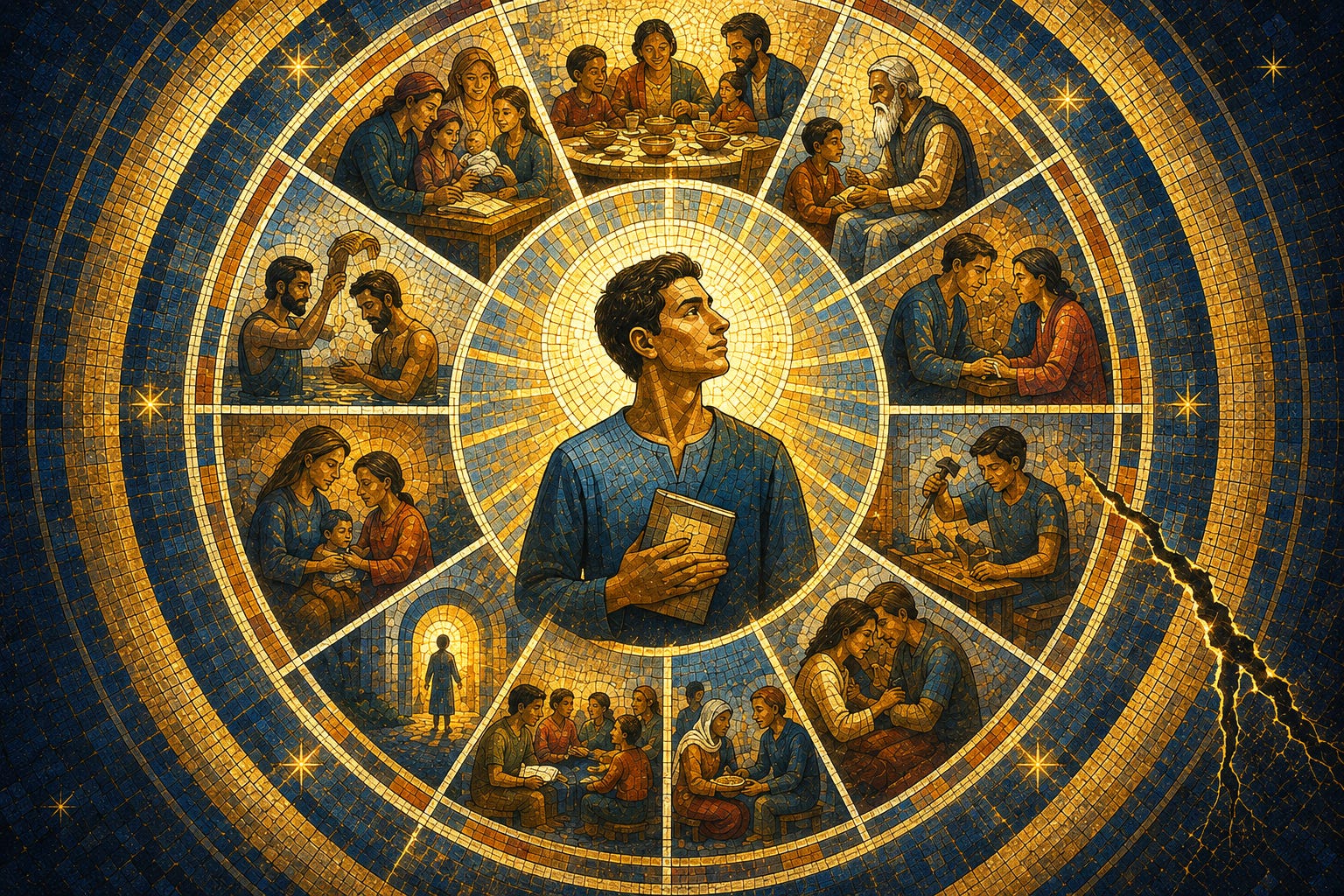
We took the machine apart and sold the parts
We did not stop having religion. We unbundled it. Therapy kept confession and repair. Wellness kept ritual. Politics kept the tribe and the moral crusade. Social media kept testimony, public judgment, and the congregation that is always watching. Brands kept symbols, belonging, and pilgrimage to the flagship store. Then each part was sold back separately.
The last time you saw Max, in the first essay, he was fifteen. By nineteen6 he had a therapist, a gym, and a group chat, and he confessed more to a chatbot than to any person. By every scoreboard the world keeps, he was winning. Every provider helped. None of them was responsible for who he was becoming, and the people who once were, he had stopped calling. The mask he wore was assembled from the failures of the room he grew up in, which means the people who ran the room helped author it. That is my reading, not his (he owes me no agreement).
I ran the audit on my own week, and it was not flattering. Confession had been outsourced to a coach (readers of How to Talk to God have met her), ritual to a gym, congregation to a group chat, transcendence to a practice I was nervous to admit in print. Each piece helps, which is what makes the unbundling stable. But no one of those providers knows what kind of person the whole system is forming, because no one of them is responsible for me. A parish, whatever else was wrong with it, was. When that responsibility has no home, it lands on families, with nothing to help them carry it. I know, too, how the silence starts between a parent and a grown child: the warm messages keep flowing, the jokes and the articles and the photographs, while the one conversation that matters waits for a better week. The quick audit revealed that I have been the one deferring.
There’s an obvious objection: I spend most of this project arguing for unbundling. Break the gates, yes: a gate bundles access and charges rent, so breaking it hands the power back. The Formation Stack bundles a process whose layers only work joined, so breaking it sold insight without practice and practice without obligation.
The nineteenth century ran a version of the experiment: it built secular communes that kept community and dropped transcendence, and the religious communes outlived them. The sharper finding: costly demands predicted survival in the religious communes; the same relationship did not appear in the secular ones (the record is in the notes)7. Unbundle rent. Do not unbundle formation.
The same stack builds saints and zealots
That doesn’t make inherited religion necessarily innocent or safe. Any powerful tool can be misused. Formation is power, and power can form the wrong person: story can turn a neighbor into an enemy, and authority can place a tollbooth between the person and God. The record holds cathedrals and crusades8, hospitals and inquisitions, abolitionists and defenders of slavery, and any serious recovery has to reckon with all of it. So the answer can’t be one official faith installed from above; The Fourth Pillar showed where a single state portrait leads. A renewal worthy of a Renaissance needs plurality, exit, criticism, and no government monopoly on the soul. And it needs keepers: the record check ended on exactly that finding. Formation is where the keepers come from.
Religion’s own answer to self-deception is confession: institutionalized suspicion of the story the ego tells about itself9. Benedict wrote a check into his Rule: on any serious matter the abbot must call the whole community for counsel, down to the youngest, because “the Lord often reveals to the younger what is best.” Hearing the junior monk was the abbot’s obligation, though the decision stayed the abbot’s. Every hustler who ever built a following knew this machinery too. At its worst, the institution exempts itself; it calls control care, calls exclusion purity, and calls its own survival service to God. A religion that requires confession from everyone except itself has turned a technology of self-knowledge into a machine for self-deception. Its formation system will produce dependents, not trustees.10
You can rebuild the whole stack with only 150 people
On the surface, this task may seem immense. It’s not. The room we need is small enough that someone notices your absence (the 150 is the often quoted Dunbar’s number) and large enough that no single leader is the whole religion. The people in it spend their time on practice and service, not content and audience: a meal shows up the week after your surgery, somebody teaches your kid to weld on Saturday, an absence gets a call by Tuesday. Teachers open the text, and they don’t own the gate. When somebody breaks something, the path is confession, repair, and return, not permanent branding, and the leader confesses too, to people licensed to contradict the official story.
And the measure is output: who leaves it honest, generous, and able to carry a load because they belonged? Those are not just happy vibes. They are specs: scale, cost, an output measure, and audit that runs to the top. I’m not claiming this room is proven. It’s a design old enough to have receipts and specific enough to test, and testing it is the point. Believer or skeptic, one warning holds: a community whose identity depends on its enemies is strengthening the tribe while weakening the person.
We have engineered the unengineerable before
The last argument I made with this shape was about biology. Everyone knew living systems were too messy to engineer, right up until the tools arrived, and then engineering biology stopped being a metaphor and became an industry11. Nobody folds a protein by hand (I spent two decades simulating just how hard that is). You engineer the sequence, and the folding happens.
A soul is engineered the same way: nobody installs a virtue directly. You build the room, the calendar, the demands, and the confession, and the person forms inside them. With people, the analogy sharpens: nobody chooses the starting sequence, and the same room forms different natures into different souls. Proteins sometimes misfold even when the conditions are right, and so do people. We can build the conditions. We cannot own who emerges.
AI raises the stakes. It’s making religious information free, the way printing did, which strips institutions down to the work only a community can do: stand beside the grave, share the meal, notice the absence, keep showing up after the feeling leaves. A model can explain a ritual. It cannot owe you anything. And a formation stack still can’t choose its own destination, which leaves the final question where The Counterfeit Hero left it: what kind of victory does the community teach people to want?
So you’re building anything meant to form people. Here’s the method as plainly as I can state it.
Write the portrait: the person you want your kids to become, specific enough to imitate. That portrait is the North Star for everything else.
Put the portrait into stories a child can remember before she can explain them. Stories are how a North Star gets into a person; they’re how we’ve always learned to be heroes.
Tie the practices to a calendar so they happen on the bad weeks too.
Keep the group small enough that somebody notices an absence, and give every member real duties to real people. Accountability needs support, and that’s what a group is for.
Decide who the whole thing serves, above even the portrait: God, the truth, the next generation, something no member owns. A purpose matters more than feeling good today.
Schedule confession and correction: a standing way for every member, the leader included, to hear the truth about themselves from people who don’t lose their place for telling it. Nobody catches their own self-deception; it’s a job you have to give to others.12
Measure the output: who leaves more honest, more generous, more able to carry a load. Measuring is what lets you fix what breaks.
Do it all together; the layers only work joined, and buying the pieces one at a time is how we got here (many times over). One warning: skip step six and the stack still works, but builds zealots instead. In hindsight, none of it is mysterious. All of it is work, and the founders already wrote the manuals. Nobody has to invent this. The job is to run it again.
You may have noticed that none of the seven steps touches the soul directly. That’s not a mistake; you can’t touch a soul directly. Engineering a soul means engineering the environment the soul forms inside. And that’s the good news: an environment doesn’t form one soul at a time. It forms everyone who lives inside it, at scale.
Religion is the technology for making people. The next essay is about the person worth making: the Trusted Builder, someone we can trust with power.
Acknowledgements: Thanks to Ernest Morrow for his discussions that led to the initial ideas for this post. And to Greg Bowman and Lara Pande for their critical reading of this manuscript.
Religion as formation. “Technology” is used functionally, not reductively. Émile Durkheim emphasized religion’s role in creating collective life; Harvey Whitehouse studied how different ritual forms support different kinds of groups; Tanya Luhrmann examined prayer as trained attention (her account is the conversation-to-relationship pipeline observed in the field); James K. A. Smith argues that repeated practices and “liturgies” shape desire, often before explicit belief does. For a believer, none of these accounts exhausts religion’s truth or meaning.
The comparative claim. The first essay calls this the best technology we have for building the model person. The comparison class is the other candidates: schools, militaries, therapeutic culture, and national ideologies each run part of the stack, and the strongest secular formers (Confucian self-cultivation, Stoic practice, the military academy) succeed by rebuilding most of its layers. Religion remains the oldest system that bundles all of them, and the only one that has replicated across civilizations for millennia. The claim is falsifiable: if unbundled substitutes matched religion’s formation outcomes at scale, it would fail.
The Formation Stack. The model person, story, ritual, calendar, community, obligation, confession, correction, repair, and transcendence are an explanatory synthesis. Different religions distribute these functions differently, and some secular institutions perform several of them.
Person and persona. Persona is the Latin word for the mask worn in Roman theater, and it survives inside the word personality. Jung used persona as a technical term for the adapted social face and paired it with the shadow (developed in The Counterfeit Hero); D. W. Winnicott described overlapping territory as the “false self” built to protect a true one. The use here is functional rather than clinical: the persona names what confession and correction operate on, and saying the mask still does a job is meant to explain why exhortation alone rarely moves it. The persona here is the demolition side of a two-layer distinction I owe to Ernest Morrow, who calls the constructed layer personality (a spokesperson built for protection, whose job is nonvulnerability) and the layer underneath personhood (the self that can attend to beauty, truth, and love rather than to what it fears). This essay is about meeting the first layer; a companion essay later this month is about what the second one rests on.
The threshold scene. The encounter in the persona section is Steiner’s “Guardian of the Threshold,” in How to Know Higher Worlds (CW 10, serialized 1904-05, book 1909; trans. Christopher Bamford, 1994). In the public translation the Guardian announces that it was formed “out of thy life-experiences and thy thoughts” and that the powers which shaped it now withdraw, leaving the work to the student. Steiner presents the encounter as a literal supersensible perception rather than as a symbol; it is used here only as an instance of story compressing a formation claim into an image a person can carry. Anthroposophy is also a cautionary case for this essay’s own argument: it built a durable formation system, complete with schools, clinics and communities, in which the founder’s word remained the evidence base. That is the failure the reciprocal-confession test above is meant to catch.
Max. Introduced in the first essay; the name is invented and identifying details are changed. The person is real.
Ritual, synchrony, and costly commitment. Several stack components have experimental and historical support. Scott Wiltermuth and Chip Heath found that moving in synchrony increased subsequent cooperation; Joseph Henrich’s work on credibility-enhancing displays argues that belief spreads when models pay visible costs for it; Richard Sosis and Eric Bressler, studying nineteenth-century American communes, found that the religious ones outlasted the secular ones, and that costly requirements predicted longevity in the religious communes, with no such relationship in the secular ones: cost bound to the sacred worked; cost alone showed no measurable effect. This is the body’s commune receipt. Two honest limits: longevity measures the institution, not the person formed inside it, which is why the body’s output measure is who leaves the room more capable; and none of this proves theology. It is evidence that the stack’s machinery does measurable work, and that the layers behave as a stack.
Cooperation and exclusion. Research associated with Ara Norenzayan, Joseph Henrich, and others argues that religious beliefs and institutions have sometimes helped scale cooperation beyond kin. The same traditions can intensify in-group loyalty, punish dissent, or sanctify conflict. The essay’s claim is about formation capacity, not an assertion that religion is uniformly prosocial. On outcomes, Tyler VanderWeele and colleagues’ cohort studies associate regular attendance with lower mortality and lower despair-related risk; these are associations with selection problems, cited as evidence of formation capacity rather than proof of mechanism.
Confession and institutional self-deception. The application of self-deception research to religion is an interpretive extension, not a claim that religious institutions are uniquely prone to it. Albert Bandura’s moral-disengagement framework and Ann Tenbrunsel and David Messick’s work on ethical fading describe how harmful conduct can be moralized or pushed out of view while the actor preserves a good self-image. The essay’s test is therefore reciprocal: a formation system should subject leaders and institutions, not only ordinary members, to confession, contradiction, and observable repair.
Trusteeship. The claim that religious leaders and institutions hold texts, authority, and communities in trust extends the fiduciary idea developed by Aaron M. Renn in “The Public Intellectuals America Needs” (2026). Trusteeship here is a normative test, not a claim that religious authority is legally equivalent to a trust. The beneficiary test is whether the institution increases participants’ capacity for judgment, responsibility, repair, and service rather than making dependence on the institution its principal product.
The biology parallel. “How to Engineer Biology,” Scientific American, November 8, 2018: an answer to the Grove fallacy, the claim that engineering principles must fail against systems evolution built. The answer there was five engineering principles and a receipt (the cost of genomics fell over a million-fold in two decades). The final section borrows the shape, not the certainty: the claim is not that souls are simple, but that engineering the conditions is an old and workable discipline even when the system itself stays beyond direct design. The disanalogy worth conceding: biology got a measurable curve (cost per genome) before it got its industry. Formation’s curve does not exist yet, who leaves the room more capable, measured across rooms, and building that instrument is part of the work.
The hustler objection. The method is public and always has been, which means people who want followers rather than trustees can run it too. L. Ron Hubbard ran a recognizable version of all seven steps and built a formation system with real staying power; what he skipped was step six pointed at himself. No member of his organization could tell the founder the truth about himself and keep their place, and the institution audited everyone except its source. The same failure appears in anthroposophy’s later history (see the threshold-scene note) and in every high-demand group that ends up in the exit memoirs. That is why step six is written the way it is: confession that exempts the leader is not a missing feature of the con. It is the con. A community evaluating any room, this essay’s included, should start there.
https://bushidorituals.substack.com/p/el-hilo-rojo-leyenda-japonesa
Something does not add-up. The animal soul is perfectly operational with only step 3 and 4 without requiring a dogmatic specification. I would argue that religion is what makes humans imperfect.