

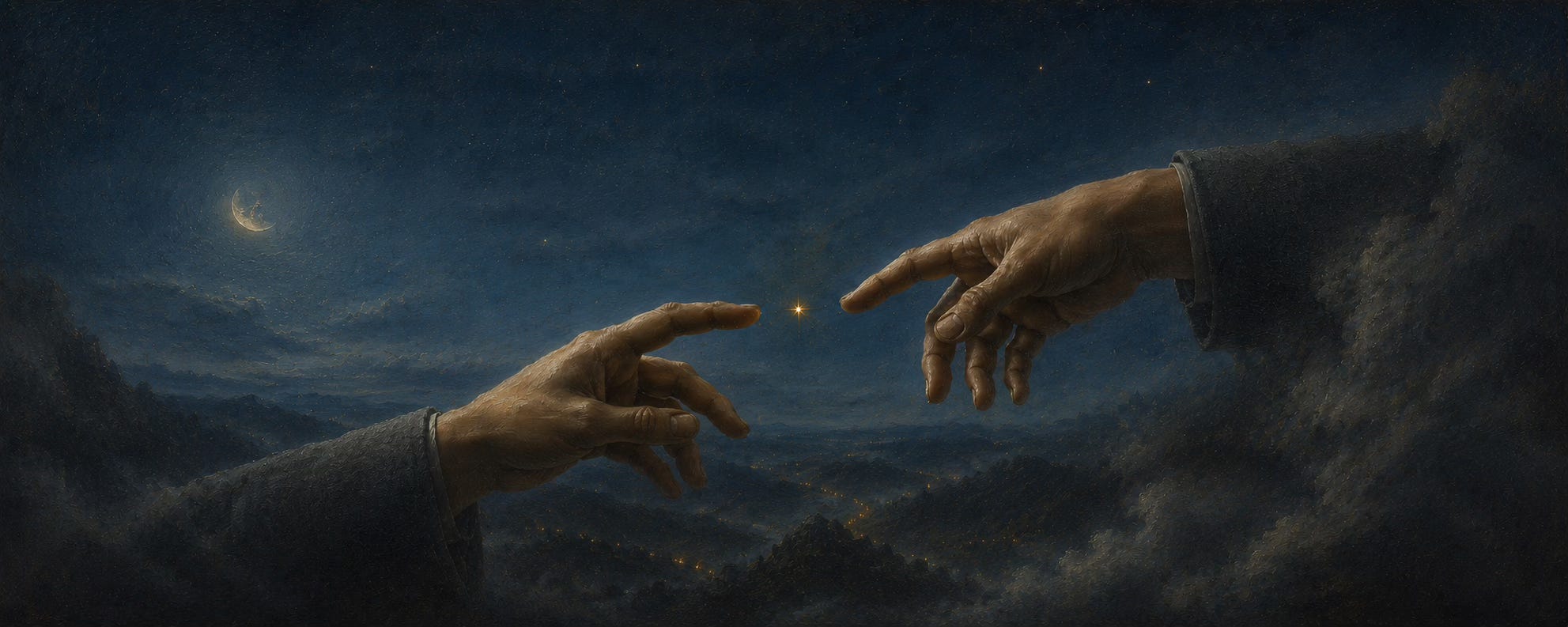
Everyone I know is circling the same question. When the machine can outperform me, what exactly is left for me? It’s the most important question of the decade, and the honest answer sounds, at first, like a joke.
What’s left is the mode of mind the machine can’t inhabit. The technique for using that mode is a few thousand years old. It’s called talking to God.
Ok, I know, that escalated fast. Stay with me, because while I mean that fairly literally, it’s also with a grounding in science. And I came to it the long way around. A few years ago a coach I’d been working with asked me a strange question. “Do you know how to talk to God?” I said no. She said, “Want to learn?”
I’m a scientist (two decades at Stanford, a few hundred papers, mostly on physics and biology and ML/AI/computation), and God is not a word I casually go to. But at that moment in my life, I was stuck on something big, and simply curious, so I said “yes.”
The lesson was almost too simple. Go to some place peaceful, ideally in nature. Ask a question. Then get quiet, quiet enough that the part of you that’s always talking finally stops, and listen for the answer. That’s it.
I tried it. I knee jerk gravitated to the most important question I had: “am I on the right path?” And the answer came back, clearly, unmistakably: “no.” I didn’t like that at all; it actually disturbed me. So I changed some real things: how I worked, where my time went, what I’d been telling myself. Then I asked again. Still no. It took several rounds, and more and more change, before I asked one more time and the no was a yes.
Was the answer right? I can’t validate the source. I can judge the consequences: the changes it forced are the ones that held up. And with every day that’s more clear to me and those around me. But here’s what I can’t shake. The answer wasn’t the one I wanted, which is the first clue it wasn’t simply conscious wish fulfillment. It was wiser than I was being. So who answered?
Me being me, I went looking for the scientific version. Here it is.
You don’t have one mind
You have more than one mode of attention. Iain McGilchrist offers a useful map: one narrow, analytic, busy breaking the world into parts; the other wide, present, and taking things in whole. The brain sometimes lateralizes pieces of that distinction, but never as neatly as the map. The pop version (left brain logical, right brain artsy) is oversimplified; both halves do most things.
The narrow mode builds the fortress of “me.” The wide one, and this is the strange part, carries a sense of being connected to everything, of being far larger than your single self. Jill Bolte Taylor experienced a left-hemisphere stroke that disrupted language and the ordinary boundaries of self, and reported, from the inside, exactly that: boundless, at peace, “at one with all that is.” She calls it Character 4.
Carl Jung reached the same place from psychology and called it the Self, and noticed something I find remarkable. He said no test can tell the Self apart from God. From the inside, the deepest layer of you and the divine look identical. Science tells us there’s no “God spot.” One lesion-network study mapped spirituality and religiosity onto a distributed circuit centered on a brainstem region—not a single spot, and not one hemisphere—and the famous “God helmet” that was supposed to zap a sensed presence into people failed to replicate. The circuit tells us the experience has a neural implementation. It does not tell us how to interpret it.
The useful claim was never a place in the head. It’s a mode: quiet the narrow, self-focused attention, and the wide, connected mode comes forward. The practice doesn’t require the right/left anatomical division. If the hemisphere story gets revised — and no doubt parts of it will be — you can lose the map and keep the distinction.
And one thing about insight is measurable: answers can arrive outside awareness. When neuroscientists watch people solve problems in a flash of insight rather than by grinding, the telltale burst shows up over the right temporal lobe just before the answer reaches awareness (Kounios and Beeman have built a literature on it). The effect survives a completely different method, too: give people a number puzzle with a hidden shortcut, let one group sleep on it, and the sleepers find the trick at more than twice the rate (Wagner’s group published that one in Nature). It is quite amazing: step away and the answer appears (I encourage you to try it! I use this trick frequently for complex tasks).
The history matches this wiring: Einstein reaching for his violin, Poincaré with his foot on the bus step, solving a problem he’d officially stopped working on. The grind prepares and verifies answers. Stepping away sometimes reveals them. That science explains how an answer can arrive outside awareness. It does not prove the answer is wise. The wide mode is a source, not an oracle.
The materialist version of “who answered?” is the part of you that isn’t the narrow, calculating mode. The wide one. Your higher self, the oldest and broadest part of you, the one that isn’t busy being you. When the loud planner goes quiet and a no comes back that’s wiser than you are, the materialist account says that’s the wide mode at work.
“Talking to God” has a plausible material description: more of your own mind, finally getting a word in. The anthropologist Tanya Luhrmann spent years inside American evangelical churches and found that this is a skill. People train their attention until some of their own thoughts start arriving with the texture of someone else’s voice. Which is possibly what my coach was teaching me, minus the theology. Luhrmann shows that the channel can be trained. She doesn’t certify the sender.
Which brings us back to the machine.
McGilchrist reads Western history as a slow pendulum between these two modes, and his reading of the last full swing is the one to sit with: the Renaissance was an era when the wide mode led and the narrow mode served — perspective geometry and double-entry bookkeeping invented, yes, but in the service of Madonnas, domes, and a new picture of what a human being could be. In his telling, the Enlightenment swung the balance toward the narrow mode, and romantic corrections aside, it has drifted that way ever since.
For five hundred years, we’ve rewarded the narrow mode
The whole modern world (reason, analysis, planning, measurement) is its monument, and it’s been so useful that we forgot the other mode was there. We started mistaking the calculating mind for the whole mind. And now we’ve built calculating minds out of silicon that beat ours, improving at a rate nothing in biology can touch. (I say that as someone who invests in it and believes in it.)
Which reframes what a renaissance actually is: not a burst of new tools — the tools show up either way — but a change in which mode leads.
Here’s the analogy that finally made the hemispheres click for me. The narrow mode traffics in the already-known: it re-presents, recombines, autocompletes. The narrow mode is the original large language model — fluent, tireless, trained on everything it has ever seen, and never surprised. We didn’t just build AI in our own image; we built it in the image of our left half. (McGilchrist, asked exactly this on camera, put AI on the left side of the ledger without hesitation — and doubted a right-hemisphere AI is possible at all, since that mode needs a body, stakes, and the knowledge that you can die.)
As AI takes over more of the narrow mode, the wide one becomes more valuable. Presence. Judgment with something at stake. Knowing what actually matters and what the whole thing is for, which is exactly what the planner can’t tell you. AI can answer “what for?” only by inheriting an objective from someone else. The machine may imitate the output of judgment. It cannot supply the fact that this is your life — and you have to live with the answer. Taylor’s method is about getting your characters into one room and choosing which one leads. The update for this decade: there’s a fifth chair at that table now, it’s the machine, and it sits on the narrow side.
Which makes the wide side, the part that can talk to God, the part you cannot outsource. We have to be whole now, in a way we’ve gotten away with faking for a very long time. And this isn’t just about staying employable: it’s the faculty the hard work of the next decade gets built out of. (More on that in the next essay.)
The zag: It’s not that tidy
So … that’s it. God is your wide mode, talking to God is whole-brain thinking, go do it because the machine can’t. Tidy, materialist, done.
But I don’t think it’s that tidy, and here’s the zag. Suppose every word of the material story is right — neurons, no miracles. That still doesn’t tell you there’s no God. The wiring doesn’t prove God. It doesn’t disprove God either.
It describes the channel without settling who, if anyone, is on the other end. If you wanted to build a creature that could talk to you, you’d put something in it that could listen: a quiet channel under the noise, a part of the mind that feels larger than itself and answers when asked. Which is exactly what we find. The wiring doesn’t replace God; if anything, the wiring is how God would reach you.
Is it neuroscience or much more? For the practice, you don’t need to settle the metaphysics. Either account gets you to the same first move: Ask a question. Get quiet. Listen. Then test what comes back. The wide mode generates, reality verifies. An answer is not an order. Whatever the source, the practice has corrected me more often than my plans have.
But where do we go from here? What does this actually get us? That’s where the library from the first essay (“The Hero with a Thousand Solutions”) returns, in essay three.
Notes: The insight findings (Kounios and Beeman) come from small laboratory puzzles — remote-associates problems, anagrams — where the right-temporal burst before awareness is well replicated. The stretch from word puzzles to Einstein-sized problems is a historical pattern, not a lab result; the body uses the studies only to show that answers can arrive outside awareness, not that what arrives is wise.
Who answered? In mythic terms, this is the call: the moment the ordinary plan stops being enough and a demand larger than the current self enters the story.
The sleep-and-insight result: Wagner, Gais, Haider, Verleger, and Born, “Sleep inspires insight,” Nature 427 (2004). Participants first trained on a number task containing a hidden rule; after a night’s sleep, 59 percent discovered it, versus 23 percent after the same interval awake. Sleep did not conjure the answer from nothing; it worked on a problem the mind had already loaded. A different method than the Kounios–Beeman EEG work — which is the point: two unrelated instruments, same direction.
The McGilchrist quotes on AI are from a filmed interview; the Renaissance-to-Enlightenment pendulum is his reading of Western history (”The Master and His Emissary,” Part II), and historians contest it — I cite it as his, not as settled. The attentional map is useful even if its hemispheric assignment proves messier than the story.
Jung’s claim that no test distinguishes the Self from the God-image runs through his late religious psychology; I wrote up the longer version separately.
Behind this: Jill Bolte Taylor, “Whole Brain Living.” C. G. Jung on the Self and the God-image. Iain McGilchrist, “The Master and His Emissary.” Tanya Luhrmann, “When God Talks Back.” Luhrmann shows that attention and absorption can train the felt channel; she does not establish the truth or source of what arrives. On the limits: the lesion-network work of Ferguson, Schaper, and Grafman maps a neural circuit associated with spirituality, not a metaphysical interpretation, and Persinger’s “God helmet” failed to replicate. And my own (unpublished) “God and the Right Brain.”
Acknowledgements: Thanks to Ernest Morrow for his discussions that led to the initial ideas for this post. And to Greg Bowman and Lara Pande for their critical reading of this manuscript.
What a wonderful examination of the whole vs parts. Steinbeck asked the same questions in East of Eden and so did Douglas hofstadter in An Eternal Braid. You rightly point out the AI so far is Left brain but Douglas suggested even the right brain AI, the so called god is a subroutine running on top of the current stack with only common sense reasoning. It is also beautifully described by Roberto Callasso in his book The celestial hunter.
I repeatedly had exactly such experiences, of profound, distant connections emerging in unguarded moments, when my tighter controller-signaling was taking a break. Having said that, some questions. (1) I thought of this simply as the biological situation (i) enlarging the search radius within my neural network from where it was seeking connections; and (ii) reducing the negative feedback couplings of the neural search. I coded this up repeatedly in my AI papers and found new optima in energy landscapes, often far from where the previous searches were stuck. When it did not happen sufficiently, I even coded up actively kicking the search farther than it wanted to go. I did not need to mention very heavy terms like god for any of this. The radius of the AI search is something we can widen on our own. (2) Of course, when we reduce negative feedback couplings, one has to be increasingly cautious about the well known AI problem of "hallucinations": these can appear very real, yet, they are only the product of the internal dynamics of the neural network. (3) For most people god is an interventionist father figure, who is to be begged for favors in their daily lives, and who is to be feared because of his real or mysterious moral judgement. How is the god of the wide-operating thinking mode related to what other people call their god? (4) Many people come to the notion of god from the assertion that the world had to be created, that humans had to be created. How is your internal wide-thinking mode related to other people's first mover and creator? If god is really just our internal thinking mode, then where and how she existed before the first human had her first thought? -- Thanks for sharing. :)