

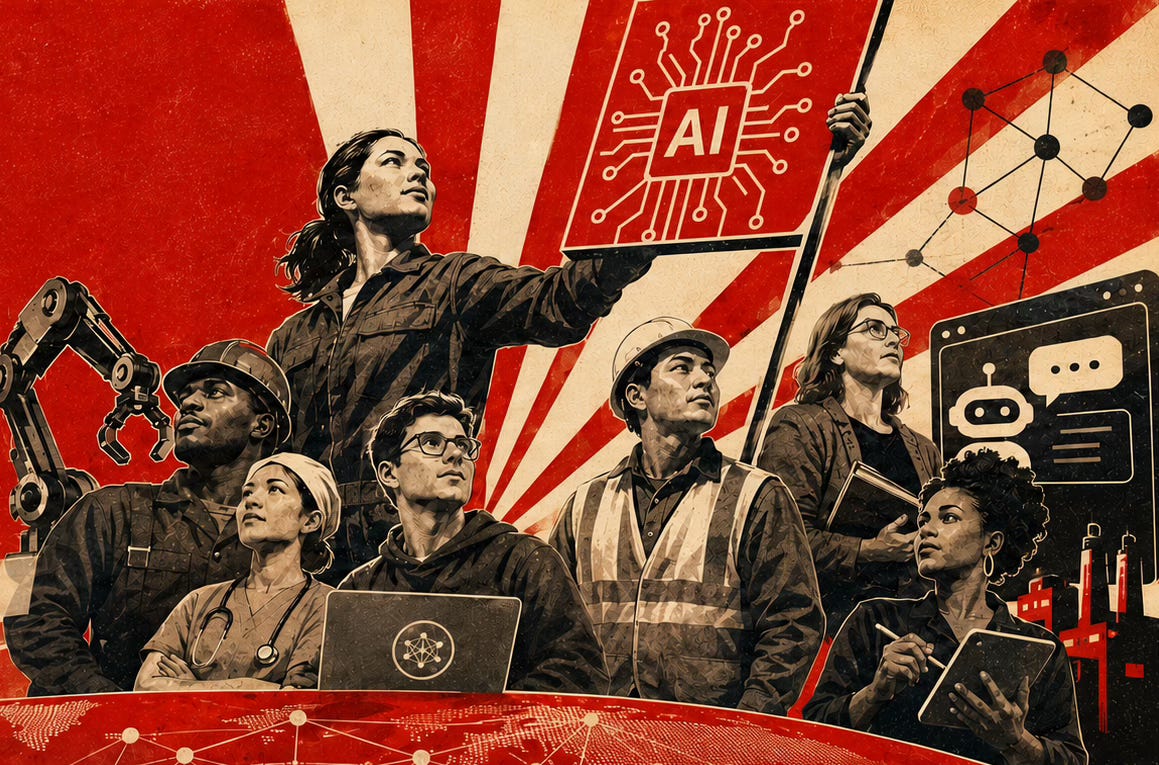
The Renaissance Papers · Series II, part 1. Series I ended at a crossroads: when machines take more of the labor, do we tax the proceeds or spread the means? This series takes the second path—beginning with how cheap machine labor can move people from workers toward owners. The map is here.
Marx’s theory of exploitation is an argument about labor as an economic force—and AI is removing the labor. Every move Marx makes runs through the worker: value comes from work. The capitalist profits by paying less than the work creates, and exploitation happens right there, on the shop floor. And we’re already seeing early signs: Labor’s share of American income has slid from roughly 64% to the mid-50s since 2000; AI bends that curve harder. AI-driven robots may finish the job.
My timing here is delicate: people are furious at capitalism, often for good reason. That fury gets its own essay next.
What’s left of a politics built around exploited labor when wage labor is no longer the central productive relationship? Not much. You can’t skim a surplus from human labor the machine no longer requires. The cost curve does the rest. Marx assumed the means of production were big and expensive—a steel mill, a railroad—which is exactly why ownership piled up in a few hands and stayed there. Fair enough, for about two centuries. In computing terms, Marxism was an argument about the hardware layer; the hardware just changed underneath it. But one critical means of production is increasingly the model, and the price of intelligence is falling off a cliff.
This is Moore’s Law again, driving cognition instead of transactions per second. Today you can download useful open-weight models for free—the learned guts of the thing—and run them on a laptop, even a phone. Near-frontier open models trail the frontier by months, not generations. The commanding heights get harder to monopolize when they can be copied. Marx wanted workers to own the means of production. The market he spent his life hating is handing them over.
The best counterargument is concentration: frontier models cost billions to train, and a handful of labs sit on the biggest clusters. True—but that misses where the leverage lives. Training is expensive; using intelligence is cheap and getting cheaper, the way building a power plant is expensive but plugging into the wall is not. Cheap access alone would make everyone a customer. Open weights are what can make them owners. DeepSeek reported spending roughly $5.6 million on the final training run for a near-frontier model, excluding the research that made it possible; open weights keep leaking the frontier outward a few months behind. The moat, such as it is, protects the plant. The revolution is at the other end of the wall socket.
The worker becomes an owner
Which points to the real revolution, and why I don’t think it has much to do with redistribution. The real revolution is the worker becoming an owner. That’s what a renaissance is built from. For most of history, the line between labor and capital was nearly impossible to cross: starting anything took money, a building, staff, expertise you couldn’t afford. Most people sold their labor and stayed on that side of the line for life.
Cheap intelligence dramatically lowers the barrier. One person with these tools can increasingly do what took a whole company: build the product, write the code, do the books, find the customers. (Midjourney reportedly passed $200 million in revenue with about 40 people and zero venture money. The one-person, billion-dollar company is coming.) Roughly 28 million American businesses already run with zero employees; the tools just promoted all of them. Not everyone needs to build a billion-dollar company. Productive ownership now works at a vastly smaller scale. The worker doesn’t need to seize the factory anymore. He can spin one up. Marx had a “reserve army” of the unemployed; what’s assembling instead is a Reserve Army of Founders.
When I say AI removes labor, I do not mean it removes work. AI lets more people cross to the other side: instead of selling only their own, they can command cheap machine labor and keep more of what it produces. That distinction is the heart of the argument. AI has the potential to promote people, just as previous technological advances have—continuing humanity’s long, unfinished promotion from slaves to serfs to salaried—now to shareholders and sovereigns.
Marx published in 1848; within eight years, Britain let any seven people register a company, and tens of thousands followed. The machinery of mass ownership was being built as the ink dried.
To be fair, Marx did see the machines coming. In 1858, in a notebook passage his readers now call the “Fragment on Machines,” he sketched an economy where machines do the producing and labor stops being the measure of value—he just bet the ending on collective ownership. He read cheap intelligence as the case for owning the machines collectively at the exact moment it became possible for far more people to command productive machines individually. Marx may even have been right about the destination: a world where nobody spends a life in wage labor. He was wrong about the vehicle, and the vehicle is the whole fight. (My best guess at what Marx himself would do in 2026: download the weights and get Engels to pay for the laptop.)
His conclusions were bolted to facts that have since flipped: scarce capital, labor as the source of value, no exit from wage dependence. Yet the slogans hang around because they’re useful for selling redistribution. Consider the universal check aka UBI. As a permanent settlement, it keeps you a client: owning nothing, making nothing, waiting on whoever signs it. A subscription to being managed. That’s closer to the techno-feudalism the left says it fears than anything the market is doing. A slice of someone else’s output doesn’t raise anyone up. The means to make your own does.
The nineteenth century asked who should own the factory. The twentieth fought over the answer. The twenty-first may dissolve the question, because the factory increasingly fits in one hand, on your phone. What we do with that fact decides whether this century’s answer is another ideology or another renaissance.
How the argument fails
None of this is guaranteed. If open models stop tracking the frontier—if that few-month gap stretches into years—my thesis dies and concentration wins after all. Same if compute prices stop falling; the argument rides on that curve. And there’s a third factor, because the weights were never the whole means of production: a model on your laptop doesn’t come with customers. If the tool layer stays open while the roads to the customer—the app stores, clouds, feeds—quietly re-toll, then ownership is a gift certificate for a store you can’t reach. The battle moves from owning production to owning distribution. Watch all three factors; the open-weights gap remains the most political number in tech. And a laid-off worker isn’t a founder yet. Closing that gap is most of the work. But the opening is real, and I think it’s the biggest workers have had in the history of work.
And let’s not pretend the transition will be painless. A 52-year-old dispatcher whose job just evaporated doesn’t want a pep talk about founding; she wants next month’s mortgage. The transition years will be ugly for millions, and pretending otherwise is how you lose them to the slogans. We need to build this right. The tools are arriving faster than the on-ramps. Checks may bridge the transition; building the on-ramps is the political project of the next decade.
But there’s an elephant in the room I’ve ignored, an obvious objection to my argument. If the market is this generous, why are people so angry at it? Rent eats half a paycheck; hospital bills read like ransom notes. The anger points at something real. I just think it has been given the wrong name, and you can’t cure a disease you’ve misdiagnosed. Before the building starts, the critics are owed a straight answer.
Why do people hate capitalism? That’s essay two, next.
Don’t robots become the new factories: the capital-intensive resource restricted to a few? There is no Moore’s Law for robots, at least not yet, but robotics costs have fallen through scale and more widely distributed know-how. The real bend comes when robots build robots and their parts, driving costs down by another order of magnitude. I expect capable general-purpose robots to approach $1,000. That is not zero, but it is on the other side of power plants and railroads.
Open weights: Llama, DeepSeek’s releases, and a rotating cast of others. The gap behind the frontier has run months, not years—that’s the number to watch. Midjourney’s figures—roughly $200 million in revenue, roughly 40 people—are widely reported but unaudited; “reportedly” is doing real work in that sentence.
Notes: The labor-share figure is the BLS nonfarm-business measure: roughly 64% in 2000 to the mid-50s. Measurement debates—proprietors’ income, depreciation—move the level, not the direction. The 28 million zero-employee businesses are Census nonemployer statistics. Most are side gigs and landlords today, which is the point: the on-ramp exists before the ambition does.
Acknowledgements: Thanks to Lara Pande for her critical reading of this manuscript.
I'm left feeling very confused. This is speaking in broad generalities and I can't envision the actualities. Everyone is to become a builder? What are the five billion individual adults on the planet supposed to generate with their five billion individual one-person companies, and sell to each other?
Aren't there an awful lot of people without the inherent ability to be ambitious solo entrepreneurs, for any number of valid reasons, even with AI support? Won't we always need chefs and people who change sheets in hotels? How will they do this unless someone organizes and employs them?
It just isn't clear how your every-man-for-himself vision would work in the real world.