

We Need a Better Game, the finale of this trilogy, closed with a design claim of five elements of that better game of “how do we win together?”: common work, divided power, public evidence, protection against defection, and room for more than one identity, make cooperation rational rather than charitable. It ended under a heading that is also a prediction, namely “reality tells you, whether you ask or not.” As a theory untested is just conjecture, this essay walks my ideas through the historical record, to see what holds and what the record adds: one republic that died, one that held, two ancient cities, the towns that invented the escape, and the oldest stories on file.
Weimar nearly escaped, and one recession ended it
In May 1928 the Nazis drew 2.6 percent of the vote. The republic had more enemies than that, communists on one flank and monarchists on the other, but the party that would kill it was a rounding error. It had survived a lost war, two coups, and the murder of its foreign minister. It had stabilized the currency, rejoined Europe, and run this trilogy’s upward loop for five straight years: shared work, visible gains, cooperation again. Five years later, with opponents jailed and deputies intimidated, the parliament voted away its own power, 444 to 94.
Under three years did the turning. The recovery ran on short-term foreign credit; after 1929 the credit thinned, and in 1931 it fled. The government met the slump by decree, with tax rises and wage cuts that deepened it, and the gains vanished: 2.6 percent became 18.3, then 37.3.1 The recession was not weather. The decree machine that would kill the republic helped manufacture the austerity that radicalized its voters.
Even then the outcome took men, not curves: the Nazi vote fell in November 1932, and Hindenburg’s circle handed Hitler the chancellorship anyway. Visible gains need a floor. A better game that cannot survive its first recession has not been designed, only launched.
How does a republic with a constitution, courts, and a free press die in five years? Weimar had the paperwork and none of the parts. Article 48 let one office rule past the parliament: in 1932 the Reichstag sat for thirteen days and passed five laws against some sixty decrees.2 The courts priced political murder by team: averaged over every killing, punished or not, Emil Gumbel counted the right’s 354 at roughly four months of prison apiece, the left’s 22 at fifteen years.3 The largest right-wing media empire and a nationalist party had the same boss.4 And the republic never built a “we”; its own best supporters were called republicans of the head.5
Gumbel’s counts were substantially confirmed by the very ministry they indicted, and changed nothing. He was driven from his university before the republic fell. Being right was not the referee. A sanction system that punishes only one side’s defections is not a weak protection. It is a subsidy.
Bonn is Weimar with the parts installed
You may suspect the total defeat did the work. But defeat had come once before: 1918 also removed a German regime, and what got built afterward was Weimar. Elimination clears the board. Design closes the game. The comparison is still not clean, since 1949 arrived with occupiers and the Marshall Plan; but the specific doors Weimar died through are the doors the Basic Law closed.
The 1949 Basic Law reads like a patch list. The presidential decree route: closed. A chancellor falls only when a majority elects a successor. Parties that play to end the game can be banned. A constitutional court no chancellor can purge sits above the players, and the press was licensed and broken up so the scoreboard would not have a single owner.6 Among its founding economic acts was the coal pool this trilogy opened with, and the identity gap got its missing layer: German and European at once. Same people, twice: 1919 parchment, 1949 function. The difference was not better Germans.
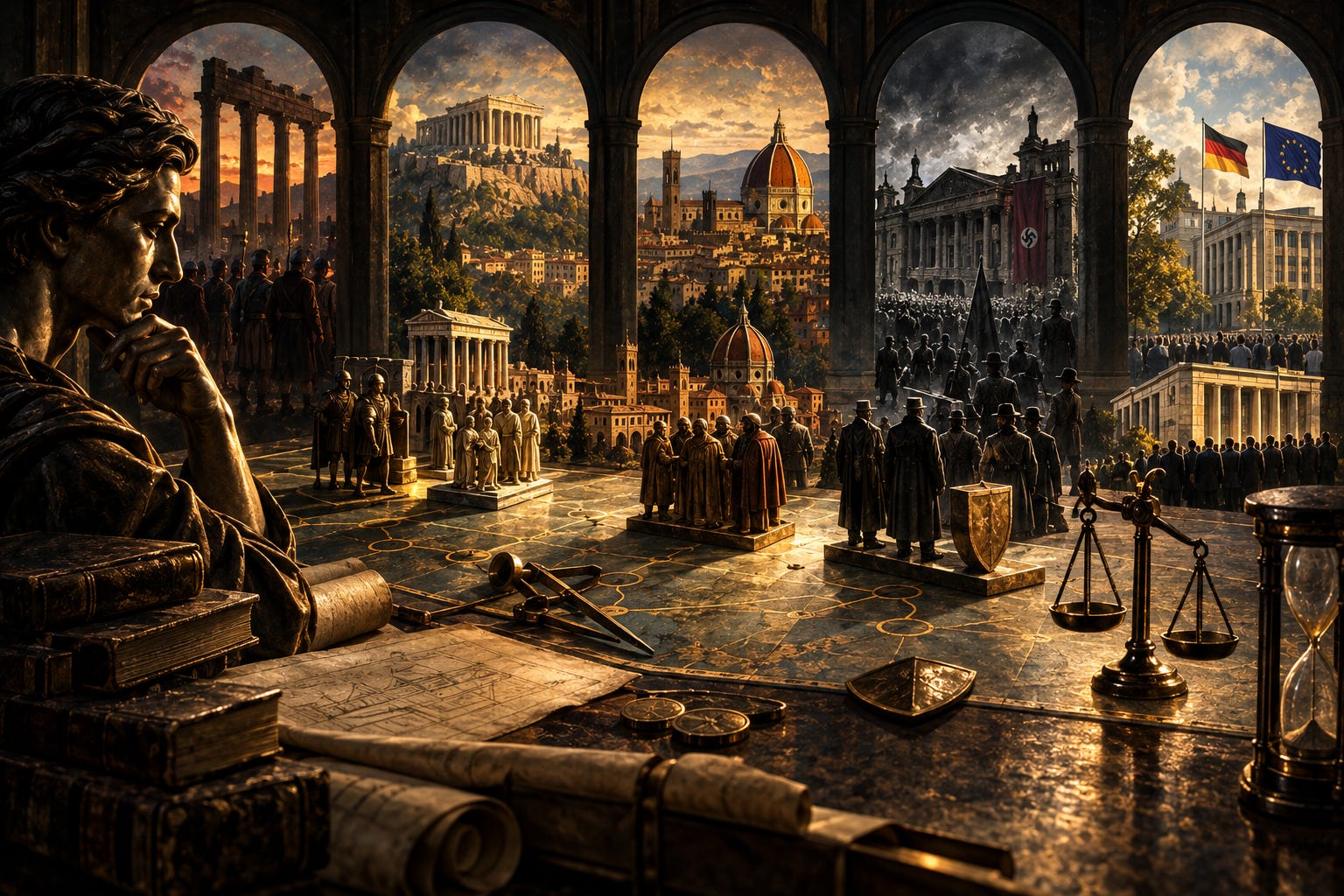
The pattern is two thousand years older than Weimar
The first essay said Rome failed at this. Durant’s record shows the failure in sequence. The tribune Tiberius Gracchus forced his land law through in 133 BC; the answer was an election-day killing, and his brother’s followers later got, in Plutarch’s count, three thousand executions. Eighty years on, the score itself was for sale, ten million sesterces for one voting bloc in 53 BC, and when purchase failed, voters were beaten and their houses burned. In Durant’s words, ordeal of battle replaced the auctioning of victory; the armies by then were loyal to generals, not to the game. A century of civil war after the first killing, the republic was a monarchy.
Athens hit the same wall 460 years earlier, and its repair went deeper: Solon cut debts, ended debt slavery, rebuilt the courts, and refused to make himself tyrant. He even installed keepers: a new council to steer the assembly, and the old Areopagus court set as guardian of the laws. The factions fought on anyway, and within roughly a generation Peisistratos took the Acropolis and ruled as tyrant. This is where the simple version of my argument breaks: redesign can change the terms of a conflict without securing the game. Installing the elements is one problem. Keeping them in force is another.7
Florence ran two games at once. Its commerce had the elements load-bearing: cargo insurance by 1300, public bonds by 1345, double-entry books by 1381, take nobody’s word for it written into ledgers.8 Its politics had them as decoration: three thousand voters, and a legal switch that could hand a commission absolute power. Cosimo de’ Medici held office rarely and power always, through loans and a tax code tuned to ruin his enemies; his summary survives: states are not ruled with paternosters, with prayers. And the two games were never sealed off from each other: the loans that bought the republic ran through the same banks that made it rich. Florence flourished where the elements were load-bearing and failed where they were decoration.9
Better games have been built from inside bad ones
The hardest objection is the starting problem: installing referees is a move in a game that has none, and Weimar shows the referees themselves defecting, from the president down to the parliament.10 Bonn’s answer was catastrophe, which nobody should have to recommend.
The medieval towns found the other way. They swore an oath and chose their monitors before any charter existed. They bought self-government from indebted lords heading off on crusade, the incumbent’s short horizon paying for the town’s long one. They played baron against bishop against king, and they repeated it, city by city, for two centuries; Tours fought twelve times before its liberty held. Catastrophe is not the only constitutional moment. Better games have been sworn, bought, and wedged into existence from below.11
The myths reached the same verdict
The oldest evidence agrees, selectively but insistently. In the Oresteia the house of Atreus is locked in the feud until Athena founds a court, and the Furies are not destroyed but housed beneath it as its guardians: vengeance given worthy work. The Haudenosaunee Peacemaker ends the mourning-wars by combing the snakes from the tyrant Tadodaho’s hair and seating him at the head of the new confederacy, under a Great Law, still in force, that also gives clan mothers the power to remove a chief. The Norse sealed the war of the Aesir and Vanir with a truce both sides spat into one vat to make. The hardest thing a founding story can imagine is not killing the enemy. It is seating him. The rest of the myths deserve their own essay, and will (eventually) get one.12
Every game gets settled. The only choice is when.
The tour sent back three requirements the five elements do not name. Visible gains need a floor. The game needs a defense against the player whose goal is the game’s end, and here the record is exact: Weimar banned the Nazi Party after the 1923 putsch and let the ban lapse within two years; Bonn moved the same power into a court no chancellor controls. And installed elements have to be kept in force, which Athens shows is a separate problem from installing them. So the record’s answer is not confirmation. The five elements look close to necessary. They are nowhere near sufficient.
Four tests come out of the tour, some from the theory and some from the record. Who can fire the auditor? Does the referee punish its own fans? What happens when the visible gains pause? And the trilogy’s coldest: can the player see the rule they are being scored by?
Weimar fails all four on the record. Bonn passes them, with the occupiers holding the door. Rome fails. Athens passes the crisis and loses the peace. Florence splits, and split is how its history went.
These are not antique questions. Ask the social feed that scores your attention who its auditor answers to. Ask either party when its referees last punished their own side. Ask what happens to the AI buildout’s visible gains, running for now on borrowed money, when the credit pauses.13 I hold a seat in that last game, which is exactly why I ask.
Every game on this page was settled, and the settlement arrived whether the players asked or not. The ones that asked early, Solon’s Athens and the towns, paid in oaths, silver, and small fights, and bought time rather than immunity. Bonn asked late and paid everything first. The ones that refused paid in centuries. And Weimar is the caution inside the lesson: Gumbel asked in time, and nobody with power listened. Reality told each of them what winning was.
What they chose was when to listen.
The loop and its reversal. Election series: völkisch and National Socialist votes of roughly two million (May 1924), 900,000 (December 1924), 800,000 or 2.6 percent (May 1928), 18.3 percent (September 1930), 37.3 percent (July 1932). The 2.6 percent was the fringe, not the whole opposition: the Communists and the nationalist DNVP together drew roughly a quarter of the 1928 vote. The turning, counted from the October 1929 crash to the July 1932 vote, took thirty-three months. The recovery’s dependence on short-term, largely American credit is standard; the mass flight of foreign credit came in 1931, with the Creditanstalt failure in May, the Danatbank failure in July, and the standstill agreements after (Ferguson and Temin, “Made in Germany: The German Currency Crisis of July 1931,” on how much of the crisis was homemade). Brüning governed by Article 48 decree from 1930 and answered the slump with deflation; Galofré-Vilà, Meissner, McKee, and Stuckler, “Austerity and the Rise of the Nazi Party” (Journal of Economic History, 2021), tie the austerity itself to the Nazi vote. Weimar’s earlier near-death, the 1923 hyperinflation, came before the recovery: in 1923 there were not yet five years of visible gains to lose, and the radicalizing sequence was gains granted, then withdrawn. Unemployment approached 30 percent by 1932. The murdered foreign minister is Walther Rathenau (1922); the coups are Kapp (1920) and the Beer Hall Putsch (1923).
The bypass and the referees. Article 48 usage: tabulations differ slightly (34 or 35 laws against 42 or 44 decrees in 1931; about sixty decrees in 1932, with thirteen sitting days and five laws); every version has the decrees outnumbering the laws. The Enabling Act of March 23, 1933 passed 444 to 94, with the Communist deputies under arrest and SA in and around the chamber; the Reichstag lingered on afterward as a rubber stamp, its power gone. The referees were the old regime’s: after the Kapp Putsch the army’s chief, Hans von Seeckt, having declined to fire on the putschists (the famous wording is attributed, the refusal is not), was promoted, the putsch ended in amnesty, and the Ehrhardt Brigade was dissolved, some of its men into the navy, others into Organisation Consul, the death squad that went on to murder Rathenau.
The Gumbel table. Emil Julius Gumbel, Vier Jahre politischer Mord (Four Years of Political Murder, 1922): 354 political murders by the right against 22 by the left; the averages are per recorded murder, punished or unpunished, not per conviction; 326 right-wing murders went unpunished against four, with ten executions, all of leftists. The justice ministry’s own review substantially confirmed his figures. Nazi agitation drove him from his Heidelberg professorship in 1932. Hitler’s 1924 treason trial produced the legal minimum, praise for the defendants’ patriotic spirit from the bench, and release after 264 days.
Hugenberg and the captured scoreboard. Having assembled the Scherl press group, the Telegraphen-Union news agency, and the UFA film studio, Alfred Hugenberg became chairman of the German National People’s Party in 1928; his 1929 campaign against the Young Plan gave Hitler his first national platform. Ullstein’s papers outsold Scherl’s; Hugenberg’s grip was the combination, the wire service that fed the provincial press plus the country’s biggest film studio. The other destroyed scoreboard was money itself: by November 1923 a dollar cost 4.2 trillion marks.
The missing “we.” Vernunftrepublikaner: republicans of reason rather than of the heart. The flag stayed a partisan fight for the republic’s whole life. The one shared national obligation, reparations, was imposed tribute rather than chosen work, and cooperating with it was branded treason; a 1929 nationalist referendum draft would have criminalized ministers signing new obligations. Hindenburg endorsed the stab-in-the-back account in testimony to the National Assembly’s inquiry in November 1919.
The Bonn patch list. Basic Law, Article 67 (constructive vote of no confidence) and Article 21 (parties seeking to abolish the free democratic order can be banned, the doctrine of militant democracy). Weimar had banning powers of its own under the 1922 Law for the Protection of the Republic: the Nazi Party was banned after the 1923 putsch and legally refounded in February 1925, and the SA ban of April 1932 was lifted that June; Article 21 moves the decision from ministers’ decrees to the Federal Constitutional Court. A narrow legislative-emergency route survives in Article 81, which is why the body names the presidential decree route specifically. The Federal Constitutional Court’s justices are protected from political dismissal rather than literally irremovable. Allied press licensing and deconcentration; the European Coal and Steel Community (1951); the Marshall Plan was already operating from 1948. Verfassungspatriotismus as named by later German political thought.
Rome and Athens. Will Durant, The Lessons of History (1968), chapters on economics and government, for Solon and the Gracchi, the vote-buying figure (ten million sesterces, 53 BC), and the sentence “ordeal of battle replaced the auctioning of victory”; the election-day killing and the three thousand executions are Plutarch’s account of the Gracchi. Durant also credits Solon with a graduated tax at twelve times the poor’s rate; Plutarch describes property classes rather than tax rates, and the figure is disputed. The Athenian Constitution credits Solon with a Council of Four Hundred alongside the Areopagus as guardian of the laws, records renewed strife after the reforms, including years when Athens could not agree on an archon at all, and puts Peisistratos’s seizure of the Acropolis thirty-one years after Solon’s legislation. The democracy Athens is famous for came a generation after the tyranny, under Cleisthenes (508 BC), and ran for roughly 180 years; the case above concerns Solon’s design.
Florence. Will Durant, The Renaissance (1953), on Florentine commerce and the rise of the Medici: the insurance, bond, and bookkeeping dates, the sortition constitution, the balia device, the franchise of roughly three thousand, Cosimo’s offices and assessments, and the paternosters line. Will and Ariel Durant’s histories end at 1815, so the Weimar material above rests on the modern record, not on Durant.
The golden-age caveat. Ada Palmer, Inventing the Renaissance (2025): the Renaissance as a retrospective construction, and the observation that a period which left golden treasures was not necessarily golden to live in. Her subject is the gap between lived instability and later myth, which is the same gap this essay assigns to Florence’s two games.
The bootstrap cases. Hindenburg was re-elected in April 1932 explicitly as the constitutional candidate against Hitler, 19.4 million votes to 13.4 million, and appointed him chancellor nine months later. In the November 1932 election the Nazi vote fell from 37.3 to about 33 percent; the chancellorship came two months afterward by appointment, not by ballot. The industrialists’ petition of November 19, 1932 carried nineteen signatures asking Hindenburg to make Hitler chancellor.
The communes. Will Durant, The Age of Faith (1950), documents the communes: the sworn associations, the purchased charters (crusading lords selling self-government), the played-off overlords, and Tours’ twelve attempts. Two limits worth naming: the towns bootstrapped inside a legal order that recognized a purchased charter, and a town is smaller than a nation; the sequence is documented at one scale and open at the larger ones.
The myths, sourced. Aeschylus’s Eumenides (458 BC), the third play of the Oresteia, stages the founding of the Areopagus court and the Furies’ installation beneath the hill as honored guardians of the city. The Peacemaker, Hiawatha, and Tadodaho belong to the Haudenosaunee Great Law of Peace, a living oral tradition with variant tellings, cited here with respect as constitutional history rather than folklore; the clan mothers’ power of removal is described in the Onondaga Nation’s own accounts. The Aesir-Vanir truce and the shared vat are in Snorri Sturluson’s Prose Edda (Skaldskaparmal); the truce held, though Kvasir, the being born of the vat, was later murdered, and the myths keep their own ledger honest. The body’s bold is a claim about the stories where cooperation wins, not about all founding stories: in the Babylonian Enuma Elish, Marduk kills Tiamat and builds the world from the body. The remaining myths of the better game are the later essay’s business.
Borrowed money. David Rotman, “What must happen for AI’s trillion-dollar gamble to pay off” (MIT Technology Review, September 15, 2026): Morgan Stanley calculates that more than half of the roughly $2.9 trillion the major AI builders will spend on data centers between 2025 and 2028 will have to come from outside their own cash flows, from debt and other people’s balance sheets. The analogy has limits: debt raised against trillion-dollar cash flows is not 1931’s callable foreign credit; the shared question is what holds the visible gains up when the money pauses.