

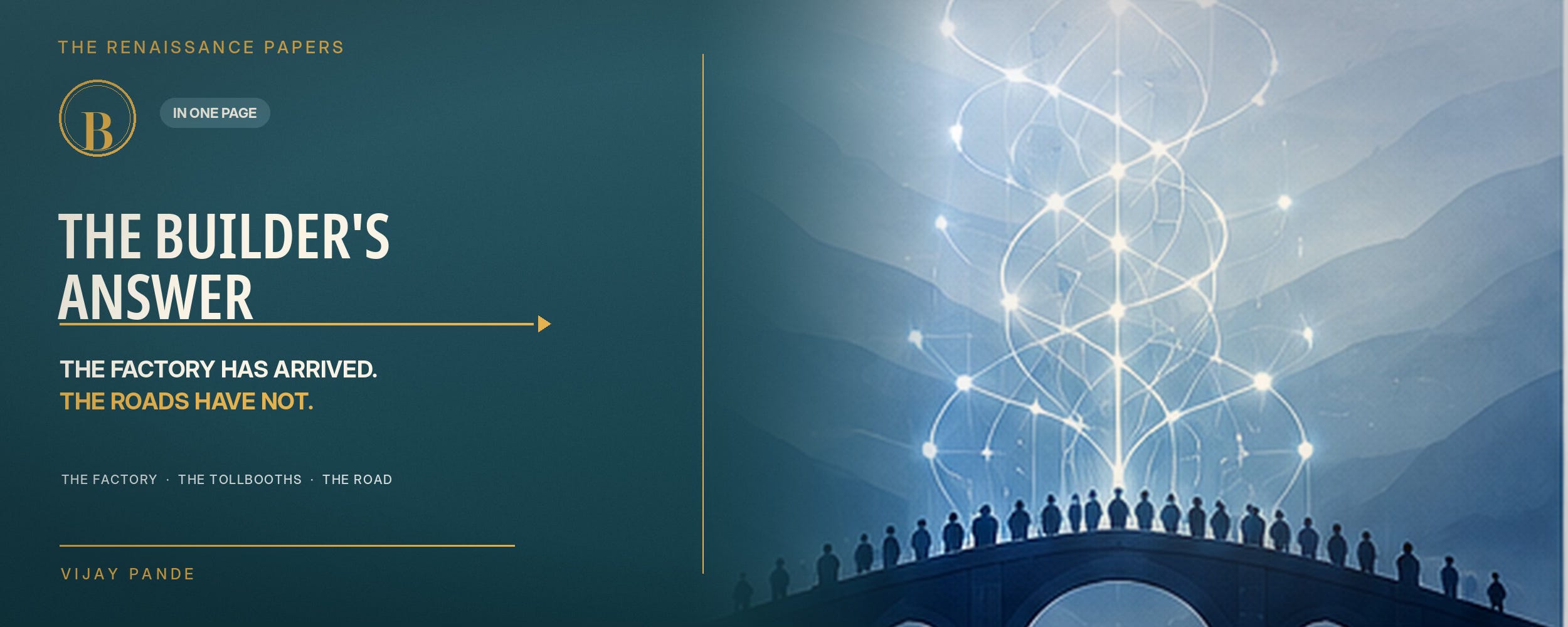
Series II of The Renaissance Papers. The essays stand alone. This page is what they add up to.
The promise of AI and the anger at capitalism are one trend seen from two sides. AI is making it cheap to produce almost anything, while the roads to the customer are still owned by gatekeepers who charge a toll. That explains the hype and the fury at once, and it points to what to do.
The first essay, Owners of the World, Unite, shows that AI is collapsing the cost of production. For most of the industrial era you sold your labor because you couldn’t afford your own means of production: staff, expertise, capital. Now one person can increasingly write the software, design the product, keep the books, and find the customers. Labor’s share of American income has fallen from about 64 percent to the mid-50s since 2000, so the pressure is real, but so is the way out: a worker who owns her tools and her output is an owner. Marx wanted workers to own the means of production. AI may deliver it by shrinking the factory instead of seizing it.
The second essay, Why People Hate Capitalism, argues that what people hate about capitalism isn’t building, trade, or honest profit. It is rent: money collected at a chokepoint, where you pay not because someone helped you but because you can’t get past them. Two tests reveal it. Does the business make more money when your problem improves, or when it persists? Does using it make you more capable, or more dependent? A business that fails both is a tollbooth.
The third essay, To Solve It, Make the Problem Bigger, runs those tests across the whole economy and finds the same business model in healthcare, education, and religion, three industries that look unrelated. Fifty years of separate reforms failed against it because each fight was fought alone, scattered publics against organized lobbies, and because the chokepoints are protected by law and licensing rather than by better service.
Put the two sides together. If production frees while the paths stay captured, the new one-person factories don’t become owners. They become clients, paying a toll on every road to every customer, and AI becomes the best tool the chokepoints ever had.
The reverse is also available: chokepoints have fallen the same way for five centuries, alternative first, users second, law last. Printing broke the monastery’s control of books; homeschooling went from outlawed in most states to legal in all fifty; flat-fee doctors and cost-plus pharmacies are doing it to medicine now.
The alternative has to pass a third test, or the game merely changes collectors: who controls the path once the new thing wins? In the essays I put the whole position in two sentences: “Capitalism versus socialism is an argument about who should own the tollbooths. The builder’s answer is that roads shouldn’t have booths.”
One clarification, because “builder” can sound like Silicon Valley talk. A builder is anyone whose work makes the other person more capable: a teacher whose students outgrow her, a doctor paid for cures rather than visits, an electrician training an apprentice. Founders qualify when their product does that, and only then. The same test applies to investors, and it hasn’t escaped me that VCs like me can become gatekeepers between founders and the money.
Owners or clients isn’t a forecast about the technology. It’s the outcome of a fight over the chokepoints. If you read one essay, read Why People Hate Capitalism. The next series asks the question this one can’t answer: once you can build almost anything, how do you decide what to build?
The trilogy: Owners of the World, Unite · Why People Hate Capitalism · To Solve It, Make the Problem Bigger
The other one-pagers: Building Our Renaissance, in One Page · The Oldest Solution, in One Page · Start Here
This is a fascinating idea that "AI makes the worker the owner." Also like the idea that mature capitalism has installed numerous toll booths that a revolution can overcome. And that we need to look at the political context even more than an economic context. The emphasis on "builders and building" as our savior rings very Silicon Valley FWIW.