

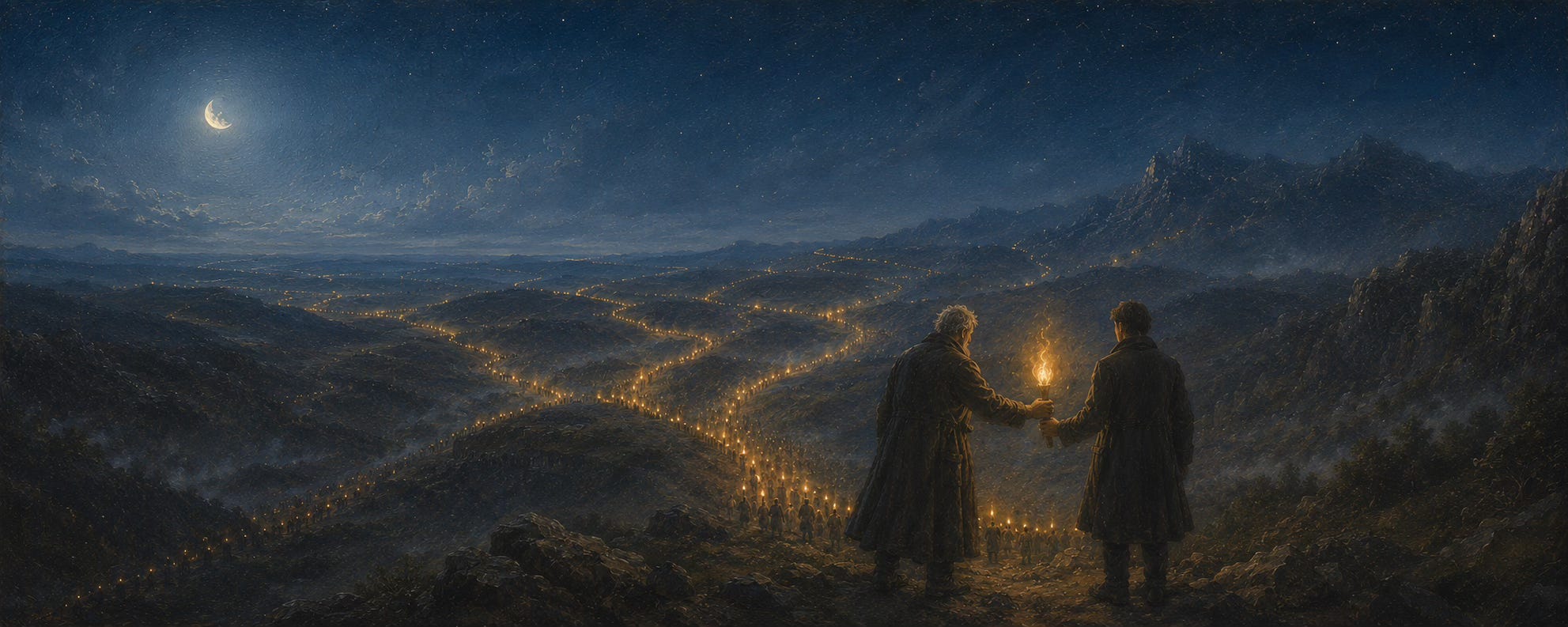
Every programmer learns the rule: call the standard library before you rewrite it. Humanity has one too: fifty thousand years of tested solutions, forked across every culture, with the broken versions deleted—sometimes only after terrible cost. We call it myth.
Joseph Campbell spent his life cataloguing that library. His claim: every hero story humans have ever told is actually the same story. Moses, the Buddha, Luke Skywalker. Somebody leaves the ordinary world, goes into the dark, faces the challenge, and comes back changed with something the rest of us need. A thousand faces, one hero. But for me, Campbell stopped one step short. Yes, the hero repeats. What that really repeats is the solution.
That matters more than it sounds, and it matters most right now. AI will make capability abundant just as the need for judgment becomes acute. It can hand more people more analytical horsepower than any technology before it, and no reliable answer to what all that capability is for. Capability is about to be free. Wisdom won’t be. Humanity has already run many of our hardest experiments, and cultural memory stores the results. The task is not to obey whatever is old. It is to search inherited culture for patterns independently rediscovered under real selection—and then know which one the present moment is calling for.
Look at what survives in the world’s myths and you don’t find random plots. You find the same handful of moves, over and over. The flood you live through by building before the rain (Noah, but also Utnapishtim in Babylon, Manu in India, Deucalion in Greece). The exile who comes back to free his people. The descent into the underworld to recover what was lost.
The point isn’t the literal boat. It is the recurring protocol: warning, preparation, remnant—heed the weak signal, build before consensus, carry what matters through the break. Some of these are likely forks: Noah possibly descends from Utnapishtim, the way good code gets copied. But the same story also surfaces in the Americas and in Aboriginal Australia, where no Babylonian scribe ever carried it. Where copying can’t explain the match, ask the engineering question: did reality (ie real life experience) push them toward the same move?
Look for independent convergence
Survival alone is a weak signal. Independent convergence, in a domain where reality consistently tests the answer, is a strong one. When the eye evolves separately dozens of times across unrelated lineages, biologists aren’t perplexed. They conclude that, given the problem “detect light,” there is a small set of good answers the world keeps pushing toward. I see the same logic for human problems. When unrelated cultures with no contact keep inventing the same move, that isn’t proof it works. But it is one of the strongest clues we get short of running the experiment ourselves, and humanity already ran it, on millions of lives, over thousands of years. Convergence is a filter, not a verdict: bloodletting converged too, in a domain where noisy outcomes protected a bad answer. The signal is strongest where reality had repeated chances to punish bad versions.
The anthropologist Joseph Henrich has the cleanest example: cassava, which is laced with cyanide. Amazonian groups process it through a fussy, multi-day routine that pulls the poison out — but skip a step and you feel fine for years, so no one could have reasoned their way to the recipe from cause and effect. Nobody did. The culture knew what no single person in it knew, and the families who cut corners quietly got sick over decades.
That’s cultural evolution: answers get selected, the way genes are, with reality doing the deleting, and they survive as “because we’ve always done it this way.” Myth isn’t the only format. Ritual, taboo, proverb, and custom carry the same distributed memory; myth is one of the most portable. (Chesterton had the blunt version: don’t tear down a fence until you know why someone put it up.)
Stories create a kind of prelived knowledge. A child does not have to destroy trust personally to understand the Boy Who Cried Wolf; the lesson arrives before the wound. At its best, the library isn’t just the research arm for humanity’s biggest problems. It is a tactical guidebook for daily living as well.
This mindset brought about the Renaissance
The Italian Renaissance was exactly this move, performed by a civilization. Florence did not invent from zero; it recovered first, then invented on top. The humanists hauled Aristotle back through Toledo, Greek texts out of a collapsing Byzantium, Roman law out of a millennium of neglect: the largest restoration of tested code in history, running on brand-new hardware (the press).
Even the era’s showpieces were library calls. When Brunelleschi needed to close the dome over Florence’s cathedral, he didn’t start with a blank page; he went to Rome and measured the Pantheon — a solution that had been sitting in production for thirteen hundred years. “The recovery of buried knowledge,” I called it in “The Fourth Pillar,” one of the four pillars every renaissance stands on. What made the great things great was rarely novelty alone. It was old, tested code, called by people who also knew how to listen for which call the moment needed.
Here’s the catch. Myths aren’t neutral. They’re memetic programs, and programs have outputs. A culture runs a story about what a human being is for, and that story helps decide what it builds.
I wrote about the starkest case in “The Fourth Pillar.” Two societies took the same twentieth-century shock. One ran the story of the self-made citizen, the covenant, the frontier you build out into. The other ran the New Soviet Man, the human as an input to the plan. Same century, much of the same technology. Different myth. One built the suburbs and the GI Bill; the other built the gulag and millions of graves. Myth was not the only variable. But it told each society what its power was for.
We’re walking into another one of those historical pivot points, and this time the technology is the most powerful we’ve ever built. AI hands us the capability either way.Which solutions we pull off the shelf, which story we run about what all that power is for, will help decide whether it ends in a renaissance or in the rubble. That is one of the most important choices our generation makes, and we’ll make it whether we mean to or not.
But which myth should we call upon today?
We are not short on solutions. We’re sitting on a tested codebase possibly fifty thousand years deep. And most of it is freely available. The question was never whether answers exist. It’s which ones we still know how to call. And the deepest one in the whole library, the solution driving the record’s biggest acts, isn’t a merely specific answer. It’s a method. Before the Ark, the Exodus, or the bodhi tree came the same move: withdraw from the noise, ask, and listen. That one also possibly has a concrete, material explanation — and it may decide whether we direct the machine or let the machine direct us.
That’s the next essay: I’ll lay out what that specific answer is, the science behind it, and how we can each reach it.
Notes: The flood-story genealogy: mainstream scholarship reads the Genesis flood as descending from the Mesopotamian tradition (the Gilgamesh and Atrahasis tablets) — that’s the “honest forks” sentence. The independence claim rests elsewhere: flood-and-survivor traditions recorded across the Americas and Aboriginal Australia, where Babylonian transmission is implausible. One asterisk: some of those traditions were first written down after missionary contact, so any single recording can be contaminated; the sheer count across unconnected regions is what survives.
On Convergence: The late-antique Neoplatonist Sallustius essentially had the line sixteen centuries ago. Writing about the myth of Attis, he said, “Now these things never happened, but always are.” Campbell later mapped the recurring form. What both leave open is the engineering question: why do some stories keep returning, and when does recurrence count as evidence that the move works?
The commonly quoted “Myths are things which never happened, but always are” is a modern paraphrase. In Gilbert Murray’s translation of On the Gods and the World, Sallustius writes, “Now these things never happened, but always are,” during his allegorical interpretation of the Attis myth. Sallustius’s claim is Neoplatonic and cosmological: the myth represents a process that subsists eternally. The argument here is narrower and evolutionary. Recurrence becomes evidence only when the story or practice was independently rediscovered and reality had a meaningful opportunity to punish bad versions.
This is why convergence needs a selection test. The fact that a story is old and universal does not prove its advice is good. Bloodletting was near-universal for two thousand years (Greek, Islamic, Ayurvedic, and European medicine all converged on it), and it mostly just bled sick people. Convergence is strong evidence only where reality could actually punish the mistake — which premodern medicine, with most patients recovering anyway, could not.
Brunelleschi: “measured the Pantheon” is compression. He studied Roman vaulting at length, and the dome’s double shell and herringbone brickwork were new engineering. The point is the order of operations: recovery first, invention on top.
The cassava routine and its logic are Joseph Henrich’s; bloodletting’s near-universality across Greek, Islamic, Ayurvedic, and European medicine is the standard history.
Behind this: Joseph Campbell, “The Hero with a Thousand Faces.” Joseph Henrich, “The Secret of Our Success” (cultural evolution, and the cassava case). Richard Dawkins and Daniel Dennett on memes. And my own “The Fourth Pillar.”
Acknowledgements: Thanks to Ernest Morrow for his discussions that led to the initial ideas for this post. And to Greg Bowman and Lara Pande for their critical reading of this manuscript.