

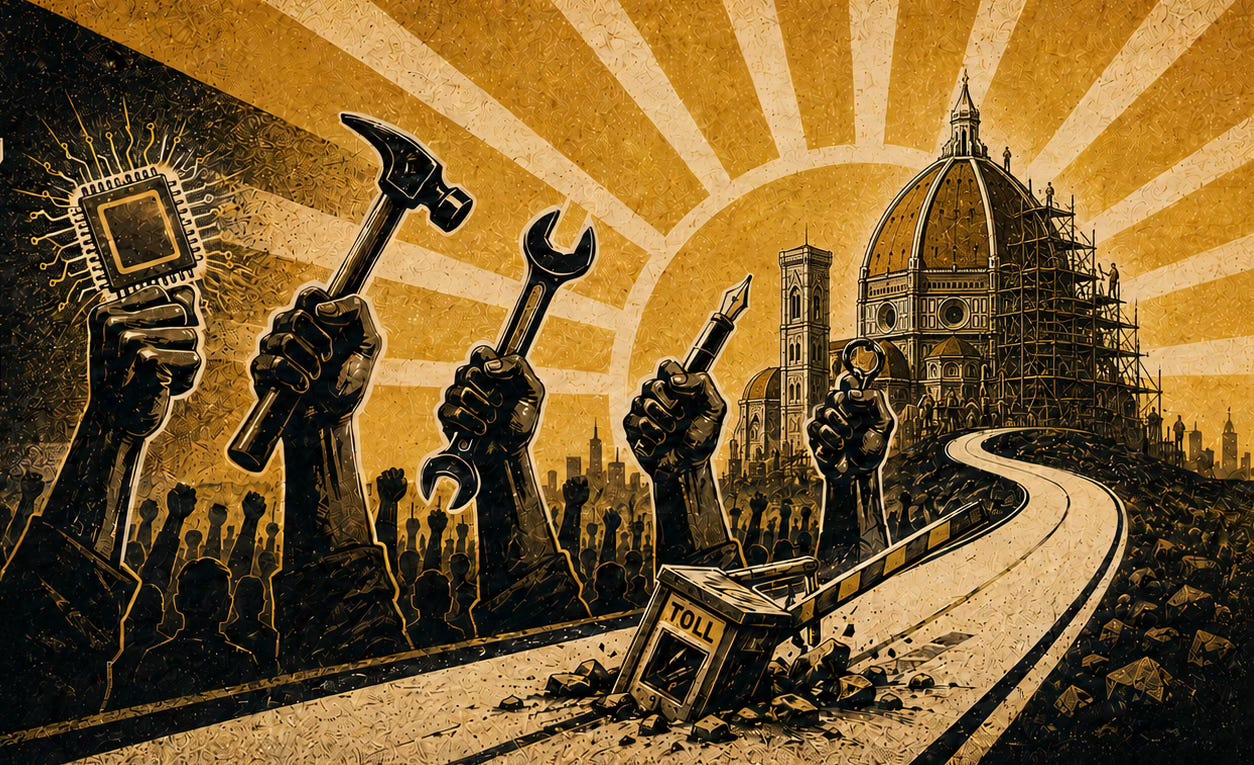
Here is a test for any institution: does it become more successful as the problem shrinks, or as it persists? And when it succeeds, does it leave you more capable, or more dependent?
We’ve spent fifty years shrinking our biggest problems individually, and that’s exactly why they won’t solve. Eisenhower supposedly said that when a problem can’t be solved, enlarge it. Healthcare reform, education reform, homelessness spending: each being fought alone, each losing ground. Small wars, same enemy. Here’s what happens when you widen the frame instead.
We have healthcare that keeps you sick, education that keeps you ignorant, and religion that keeps you from God. The target throughout is the toll—the profit from owning the gate—never the faith, the medicine, or the learning. Three industries, one recurring business model. Each stands between you and something you want (health, understanding, transcendence), charges for passage, and holds a quiet financial interest in you never quite arriving.
That is the distinction: a gatekeeper earns more from managing the journey than from helping you arrive. (Health economists have a name for this — supplier-induced demand: the gate creating its own traffic.) Essay two (”Why People Hate Capitalism“) called this rent seeking. At this scale it needs a bigger name: The Gatekeeper Economy.
Run the Sickcare Test from essay two—does revenue rise as the problem shrinks, or as it persists? California spent roughly $24 billion on homelessness over five years, homelessness went up, and the state could not consistently say what the money bought. (The housing chokepoint built the trap, and a services industry then grew around not springing it — the gates stack.) College tuition has risen something like 1,200% since the late 1970s; are graduates twelve times more educated? Every gate above passes the test.
Add the gates up and the number gets uncomfortable: the counts run from single digits to a quarter of GDP, depending on who’s counting, and the lowest number on the table is still trillions — a Gatekeeper Economy hiding inside the real one.
We’ve run this experiment before; the religion case is the oldest. The medieval church sold indulgences: cash for grace, the purest toll ever charged. (Its descendants sell subscriptions: meaning as a service, seventy dollars a year to sit quietly.) Then the printing press cut the price of a book by something like 90% inside two generations, Luther posted his complaint, and the gatekeeper lost its monopoly within a generation. Every technology that collapses the cost of access breaks the priesthood built on controlling it. AI is the printing press pointed at the remaining ones.
How do we have the opportunity to enlarge it now? Because AI is about to make the gates more valuable than ever—or worthless. It can cheapen the bypass, or automate the booth. AI spins flywheels (systems where each turn makes the next easier). Faster flywheels can mean steeper power laws, and steeper power laws can mean a few winners holding nearly everything. So the question is not only whether power concentrates, but where—and whether builders or tollbooth operators control the compounding loops.
How do you remove a gatekeeper?
Fifty years of reform bills politely asked the gates to charge less, and the gates read the petitions and raised rates. Again and again, what seemed like sturdy gates fall the same way: bypass, quorum, ratify. Someone builds a road around the booth. Enough people take it while it’s still not fully reputable. The bypass turns diffuse anger into concentrated benefit; its users become the constituency. Then the law shows up last, in a crisis window, to pave what everyone is already driving.
Luther, above, gave us the instruction manual: he didn’t ask Rome for cheaper grace — he shipped a replacement (scripture in German, worship without the toll); the pews filled before Rome could organize; the princes made it law. Homeschooling ran the same play in living memory: effectively outlawed in most states in 1980, families defected anyway, prosecuting hundreds of thousands of parents became absurd, and by 1993 it was legal in all fifty. And notice what enlarging the problem just bought. Reforms don’t transfer — a healthcare bill is useless against the credential racket. The engine transfers. One engine, five rackets. That’s what bigger buys.
The bypasses are already open for business. Mark Cuban’s Cost Plus Drugs sells generics at cost plus a posted 15%; some land at a tenth of the pharmacy-counter price — a road drilled straight around the PBM booth. The Surgery Center of Oklahoma has published its cash prices online since 2009, routinely a fraction of hospital list, and direct primary care runs medicine for the price of a gym membership, no billing code in the building.
The credential gate is cracking: Maryland, Pennsylvania, and Utah have dropped degree requirements for most state jobs; IBM and Google for much of their hiring. And housing, the oldest booth of all, just produced the decade’s best evidence that the diffuse side can win: YIMBY turned zoning from a council secret into a moral argument, and Minneapolis, Austin, and a growing list of states rewrote the rules (Austin’s falling rents — essay two — are ratification on a receipt). Each of these is the engine, mid-cycle: a road open, filling, waiting on its window.
One rule before anyone builds the next road: the bypass can’t be a cheaper toll. It has to be a different road — one that doesn’t grow a booth of its own. It may charge for the road; it can’t earn more by keeping you from arriving. The design spec is a century old. Maria Montessori showed that a child in a prepared environment teaches herself to read; the adult’s job is to arrange the room. Learning is the default behavior of a child in the right environment (ask any parent whose kid taught herself YouTube).
Let’s transfer that mindset. Montessori for healthcare: arrange life so health is the default behavior (the walkable neighborhood, the kitchen, the sleep, the pickup game) rather than a service purchased after failure. Japan already builds cities where walking is the default; its obesity rate sits under 5%, against our 40%. Or look at Alcoholics Anonymous — peer-run, free, and a 2020 Cochrane review found it matches or beats the professional alternatives. One of the most successful healing networks in history charges no toll. Montessori for meaning: practice, play, community. At the minimum, we make the new behavior default; at its best, we make it engaging, almost seeming like play.
In every case you stop paying the gatekeeper to stand between you and the goal, and redesign the environment so you grow toward the thing yourself. A builder’s product is not just the outcome; it is your growing ability to reach it without the builder. (I’m arguing by analogy and I know it — the full Montessori hospital hasn’t been built yet. Someone should build it; that’s a startup, not a metaphor.)
Gatekeeping is everywhere. It hasn’t escaped me that VCs can become gatekeepers, between founders and LPs with a well-defined toll (2 and 20). Gatekeeping is a common play you can easily see once you’re looking for it, including journalism, politics, publishing, entertainment studios, etc. Tech at its best creates new ways around these tolls through a common solution: democratized distribution. In fact, that’s how you’re reading this right now.
The gatekeeper’s product was never health or knowledge or God. It was the gate.
The gatekeepers have willing customers—and all of us have been one
The unfortunate universal core to many of these issues often goes unspoken: literally or metaphorically, can you heal someone who wants to stay sick? Or, more directly, someone who has been paid, gently and for years, to stay sick? Educate someone paid to stay ignorant? Sickness, helplessness, and victimhood all pay — in attention, in absolution, in benefits, and in the deepest currency: an excuse.
The pitch runs, you’re perfect as you are, and anything you lack was taken from you, so the system owes it to you. I’d love to claim immunity; I do here and there catch myself running that pitch, setbacks reframed as somebody else’s doing. Nobody is immune –– it’s the most comfortable lie on the market. It’s also the gatekeeper move again, aimed at the bottom instead of the top. Rent seeking is money for the position I hold, not for what I build. Entitlement is stuff for the identity I hold, not for what I become. Same disease, different hosts.
Widen the frame one more step and the century’s biggest argument collapses the same way. Capitalism versus socialism is an argument about who should own the tollbooths. The builder’s answer is that roads shouldn’t have booths.
The pitch gets one thing exactly backwards: the getting was never the point. If your parents had “helped” you by carrying you everywhere, you would never have learned to walk, and nobody would call that love. Ask any physical therapist: we heal by doing. Every real acquisition is built, and the building is the acquisition. Essay one said a slice of someone else’s output can’t raise you up. Here’s the mechanism: the raising was always internal. The institutions worth building leave you stronger than they found you.
The fix runs through culture before it runs through policy, and not because culture is the soft option. It’s the only arena with winning math. Why People Hate Capitalism left a problem standing: concentrated billions beat diffuse forty-dollar losses every time, and enlarging the war makes that worse on paper: your side gets more diffuse, and five rackets facing one movement will pool their lobbyists. Olson’s asymmetry is unbeatable in the statute book. Culture changes the math: it turns diffuse irritation into a shared identity. You can’t beat this one on one. Lobbying can block any bill; it has never once bought back lost respectability.
Movements change what people admire; markets follow; the statute book ratifies. We made smoking embarrassing — teen smoking fell from about 36% in the late 1990s to under 2% today. Same story with drunk driving — MADD, one grieving mother, 1980; the per-person death rate has since fallen by more than half. Nobody ever passed a law against smoking at dinner parties; the room just turned.
Cultures can turn. Imagine the same shift here: being a gatekeeper becomes embarrassing, and being a builder — of your body, your mind, your business, your soul — the admired default. Capitalism at its best is exactly that culture: self-improvement compounding until it shows up in the world as things built, problems shrunk, lives extended. Concretely: pick one gate you’re paying at and walk around it yourself this year. Cook. Lift. Teach your kid to read. A movement, at day one, is a few people quietly defecting — that’s how the road fills.
The real work
And now take Eisenhower all the way, because the problem has one size left. The last time a technology collapsed the price of knowledge like this (Gutenberg, again), the aftermath ran far past anyone’s reform agenda: it ran to Florence, to perspective, to the uomo universale, the Renaissance man — a new portrait of what a human being could be. Enlarged to its true dimensions, this stops being healthcare reform, or education reform, or any reform, and becomes the work of bringing forth a renaissance — on purpose, this time. A renaissance is a civilization that expects people to become more—and builds the conditions for it.
Five times before, by my count (my full accounting is in “The Fourth Pillar“), a shock like this has forced a society to redraw its portrait of the human being. The ones that drew growth got golden ages; the ones that let the cheapest answer draw it got the graves. The Gatekeeper Economy is what a civilization builds when its picture of a person is a customer: managed, absolved, waiting. The builder is the other picture. And I mean builder in the full sense — someone who owns their means and uses them to hold real things: a craft, a household, a place, people who count on them. Every gate you walk through yourself is a brushstroke on it.
Just as I asked you to grade essay two in 2031, this claim should go on a clock too. “Renaissance” is not a mood; it has a needle. I keep a gauge of the hollowing in “Build the Ark” — trust, cradles, friendship minutes, deaths of despair. If a movement of builders is real, that needle starts to turn inside a decade. If it doesn’t, I was wrong about the mechanism, not just early.
The tools are on the table (Owners of the World Unite: the factory now fits in one hand). The tollbooths have been named (Why People Hate Capitalism). So: build the bypass, fill it, then let the law ratify the road. Movements get installed in the window a crash opens, and the cheapest answer on the shelf wins that window unless a better one is already built.
And if you deploy capital for a living—investments or donations or company building, apply the same screen—the first question is one line long: does this business get paid more when the problem shrinks, or when it grows? And when it succeeds, does it leave the customer more capable—or more dependent? What remains is the oldest question, the one every gatekeeper is paid to keep you from asking: do you want to be better? I’m betting far more of us do than the gatekeepers assume.
In this light, the impossible becomes merely a tremendous amount of work.
Make the problem Renaissance-big. Then build the bypasses. And break the culture of gatekeeping.
Notes: I first heard the mindset of “in order to solve a problem, make it bigger” from Todd Park, co-founder of Devoted Health. I was delighted to see that President Eisenhower had a similar mindset.
Builder mindset: If enlarging the problem sounds like the opposite of what I tell founders (narrow the wedge, win the beachhead), it’s the same discipline at two altitudes. The frame is where you enlarge. The first move stays one gate wide.
Counting the rent: Krueger’s original licensing estimates (1974) ran 7–15% of national income; Laband and Sophocleus put America’s transfer-chasing as high as a quarter of GDP. They’re counting different things — licensing rents versus everything spent chasing transfers — which is why the body takes only the floor: even the lowest number is trillions.
California’s homelessness figure is the state’s own audit: roughly $24 billion across five fiscal years (2019–23). The auditors’ sharper finding was that the state couldn’t say what the money bought — no consistent outcome tracking. That’s the farming signature.
The tuition figure is the BLS sticker-price series: about 1,200% since 1978, several times general inflation. Net-of-aid prices rose less — and the $1.7 trillion in debt (essay two) says the difference still landed on students.
Japan’s obesity rate is the OECD measure (BMI ≥ 30), the same cutoff behind the U.S. number, so the 5%-versus-40% gap is apples to apples. Japan’s domestic definition is stricter still.
The AA finding is the 2020 Cochrane review (Kelly et al.): manualized twelve-step programs matched or beat CBT and other clinical treatments for sustained abstinence.
Teen smoking: 36.4% in 1997 (CDC) to under 2% today — some nicotine moved to vapes, which is the honest asterisk; the cigarette culture still died. Drunk driving: per-capita deaths down more than half since MADD’s founding (NHTSA) — with the statutes (per se limits, the 21 age) arriving after the norm turned, which is the essay’s sequence.
The bypasses: Cost Plus posts cost plus 15% and fees; the Surgery Center of Oklahoma has posted cash prices since 2009; Maryland (2022), Pennsylvania (2023), and Utah (2022) dropped degree requirements for most state roles; homeschooling went from effectively outlawed in most states around 1980 to legal in all fifty by 1993 — prosecution collapsed before the statutes changed, which is the quorum step working.
Acknowledgements: Thanks to Lara Pande for her critical reading of this manuscript.
Amazingly astute essay! You have no idea how accurate your observations are for me personally. I’ve been fighting this war in dental implant healthcare for over 30 years. It’s people like you and Dr. Uma Valeti (Upside Foods) that are really moving the needle for everyone.
Question- How can I get more in the fight with you guys ? I’m ready to go.