

History did not wait for saints. Florence was full of ambition, vanity, family rivalry, political calculation, and people who wanted their names attached to work that would outlive them. Rome didn’t collapse because every decent citizen suddenly disappeared. Much of the same human material was present in both.
We do not need better people. We need to change the market in which ambition competes.
Every civilization has a Status Market
A society pays people in more than money. It pays in honor, office, attention, access, imitation, and memory. The civilizational question is not whether people want status. They clearly do. The question is what an ambitious person must do to become important. A Status Market is a civilization’s casting system: it decides who gets treated as the hero.
A Status Market also prices certainty. In a healthy one, confidence has to cash out in clearly demonstrable successes. In a dark one, the leader increasingly controls the interpretation: failure proves sabotage, criticism proves disloyalty, and revision proves weakness.
Florence routed a remarkable amount of competition through workshops, libraries, chapels, paintings, and public buildings. The Medici wanted influence and memory; Brunelleschi wanted the cathedral dome nobody yet knew how to build. Its achievement was making much of that energy pass through work that enlarged the city.1
A healthy Status Market doesn’t ask whether the motive was pure. It asks what the motive had to produce.
Toynbee described the moment the market flips
A creative minority earns imitation by answering a real challenge. It organizes the city, writes the law, opens the trade route, or solves the engineering problem. People follow because the method works.
Then its successors inherit the office, the institution, and the story of why people like them deserve to lead. Historian Arnold Toynbee called the result a dominant minority, a group that has lost the ability to earn imitation but retains enough power to demand obedience. A creative minority has to solve the problem to earn status; a dominant minority uses status to avoid solving it.
In mythic terms, the creative minority earns the hero story: it meets the challenge and returns with a gift. The dominant minority inherits the costume and demands the honor without repeating the ordeal.
Modern status research gives the two routes simpler names. Prestige is conferred for valued skill, knowledge, generosity, or teaching. Dominance is conceded to people who can intimidate, exclude, or punish.2 Humans can rise through either route, but narcissism, manipulation, and callousness travel much better on the latter.3 I watch both routes compete every week in my own industry; the second is faster, and the first is the only one that compounds. I’ve taken the faster one more often than I’d like to admit.
The people may not have changed much. The route to status has.
Peter Turchin calls another pressure elite overproduction: a successful society can create educated, ambitious aspirants faster than positions capable of absorbing them. The chairs stop multiplying; the candidates do not (ask any assistant professor). At first they compete by building a better table, and later by pulling chairs out from under one another.4
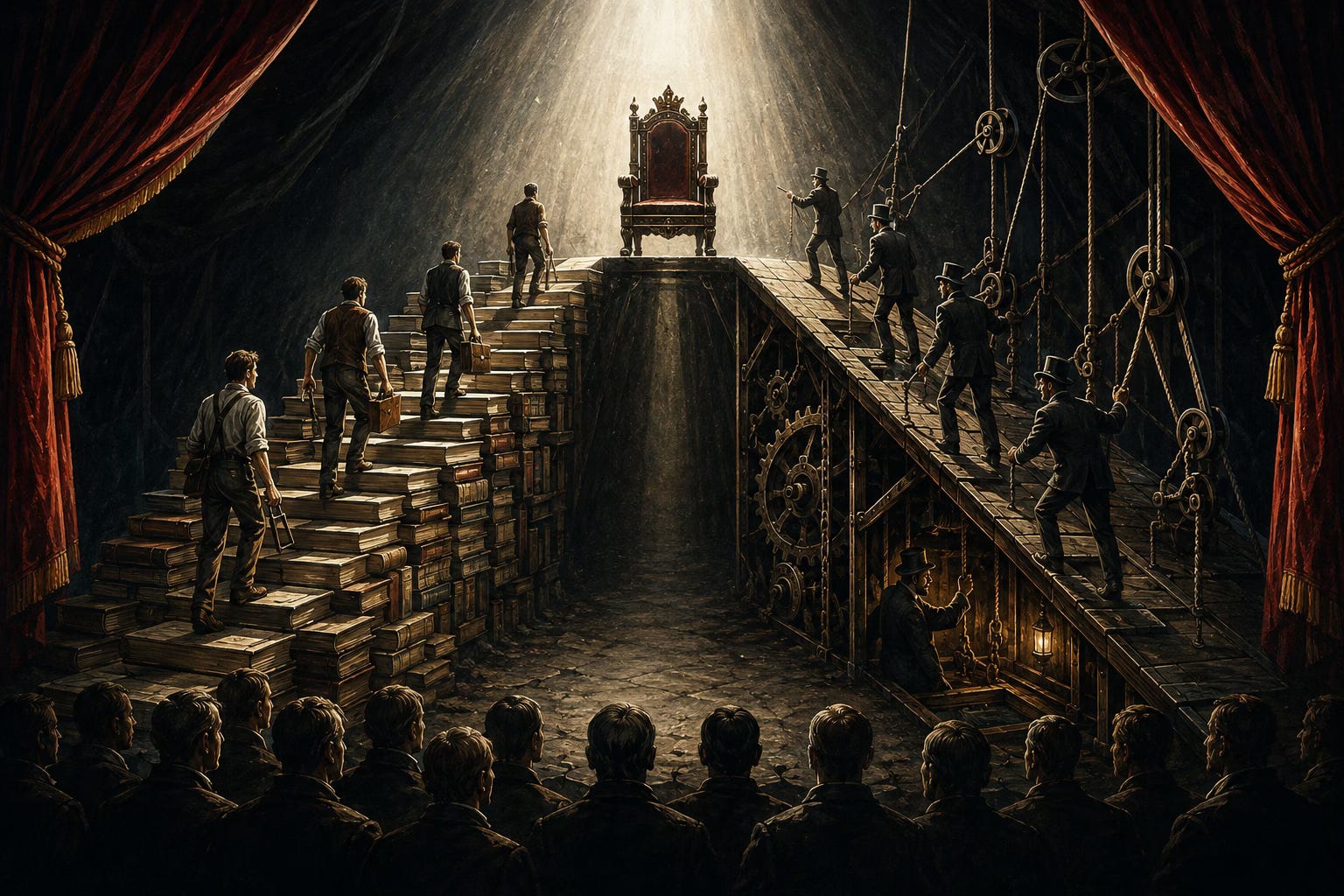
That is when the Dark Premium becomes a Dark Equilibrium
I call the “Dark Premium” the extra return for imposing costs others will not. A Dark Equilibrium is a game in which bad strategies become individually rational even for people who would prefer a better one. One faction breaks the rule and wins. The next breaks it too, because restraint now looks like exposure. Trust falls, cooperation becomes more dangerous, and the rule-breaking strategy pays even more.5
The strategy doesn’t spread naked. It travels inside a hero story.6 Some copy the tactic: break the rule, seize the advantage, call it necessary. Others follow the lie: the leader is protecting us, the critic is betraying us. What the leader cannot own as vanity, aggression, or control is projected onto the critic.7 The wolf is most dangerous when both wolf and flock believe he is the sheepdog.
The costume comes with a prop: the counterfeit hero needs a counterfeit villain. A real hero returns with a gift; the counterfeit seized the role without the ordeal, so he substitutes a threat he is protecting you from. And the threat does double duty as cover, since every failure can be charged to the enemy’s account and every critic recast as the enemy’s agent. There is a test, and it is the same one this project runs on institutions: watch whether the threat is ever allowed to shrink. A real protector works to retire the danger and stand down. A false villain is a crop. It gets farmed.
Every faction already believes it has found the true shepherd. The institutional question is how to keep anyone from controlling the flock, the evidence, and the appeal at once.
This gives delusion a status advantage. The self-deceived leader can speak with clean certainty; the person still answerable to reality keeps checking, qualifying, and revising.8
The late Roman Republic shows this very mechanism. Roman politics was never peaceful, and its breakdown did not follow one clean ratchet. But exceptional tactics became precedents. In 88 BCE, Sulla marched his army on Rome; his enemies later seized the city. After returning, Sulla institutionalized political killing through the proscriptions: published lists that made killing a named citizen legal and handed his property to the killer.9
The first norm breaker may have unusual traits. The second needs only a memory. Once an opponent has marched an army on Rome, refusing to build one stops looking honorable and starts looking suicidal. A dark personality may discover the strategy; ordinary ambition completes the distribution. The strategy becomes the environment.
Weimar compressed the same pattern. The Nazi Party existed before the Depression, but remained electorally marginal, receiving 2.6 percent of the vote in 1928. It rose to 37.3 percent in July 1932. The crisis didn’t create Nazi ideology; it changed how many people were willing to treat it as an answer.10
Economic pain alone didn’t deliver Hitler. Weimar also carried military defeat, political violence, antisemitism, nationalist resentment, weak legitimacy, fragmented parliamentary government, and emergency powers. Conservative elites then brought Hitler into government because they expected to use his popularity and contain him. They were wrong. No one has to stop seeing themselves as decent.
Civilizations do not rise because good people defeat bad people
They rise when even mixed motives have to produce public goods.11 They fall when even decent people conclude that restraint is unilateral disarmament.
That may sound discouraging, but it is more hopeful than a story about moral decay. A population corrupted in its essence would be nearly impossible to repair. A Status Market can change, and history shows it changing repeatedly.
Florence was oligarchic, unequal, factional, and frequently violent. The narrower claim is that elite rivalry and patronage also produced workshops, art, architecture, scholarship, and institutions that became durable shared assets.12 These are recurring mechanisms, not a civilizational clock. Every crisis is not Rome, and economic pain doesn’t automatically produce dictatorship. The useful questions are narrower: what must an ambitious person do to gain status here, and what must an ordinary person do to remain safe?
If the same drive can build a dome or buy an army, the answer is not to eliminate ambition. It is to build a Status Market in which the road to honor runs through shared capacity, certainty has to cash out in results no faction controls, and repeat predators never gain custody of the rules.
A society goes dark not when bad people appear. Bad people are always available. It goes dark when everyone else follows suit. The true villain of this story is the game itself. The people in it have taken a role, and a role, unlike a nature, can be handed back.
We do not need better people. We need a better game. Next week’s essay lays out how we get one.
The Counterfeit Hero trilogy concludes next week in Part 3, “We Need a Better Game.”
Acknowledgements: Thanks to Ernest Morrow for his discussions that led to the initial ideas for this post. And to Greg Bowman and Lara Pande for their critical reading of this manuscript.
Florence. Florence was oligarchic, unequal, factional, and frequently violent. The narrower claim is that elite rivalry and patronage also produced workshops, art, architecture, scholarship, and institutions that became durable shared assets. See Dale Kent, Cosimo de’ Medici and the Florentine Renaissance; Richard Goldthwaite, The Economy of Renaissance Florence; and Lauro Martines, Power and Imagination.
Toynbee, prestige, and dominance. Creative minority and dominant minority are Toynbee’s categories in A Study of History. His grand cycle was criticized for loose units, selective comparison, and weak operational measurement; the essay uses the distinction as a lens, not as a historical clock. The modern status distinction comes from Joseph Henrich and Francisco Gil-White, “The Evolution of Prestige,” Evolution and Human Behavior 22 (2001), and Joey Cheng and colleagues, “Two Ways to the Top,” Journal of Personality and Social Psychology 104 (2013). Those studies concern routes to rank, not civilization-level rise and fall; the bridge to the Status Market is this essay’s synthesis. The “hero’s costume” formulation is this essay’s synthesis of Toynbee’s creative and dominant minorities with the account of the hero in The Oldest Solution who meets a challenge and returns with something the community needs.
The psychological claim. The essay does not equate founder confidence with narcissism, coalition-building with Machiavellianism, or emotional distance with psychopathy. These are neighboring capacities, not interchangeable constructs. The claim is that useful capacities can shade into darker strategies, and that institutions may reward the higher dose. The underlying framework is Paulhus and Williams, “The Dark Triad of Personality,” Journal of Research in Personality 36 (2002).
Khaldun and Turchin. Asabiyya includes group solidarity, collective capacity, and sometimes fierce in-group loyalty. Khaldun offers a parallel account of how successful ruling groups become insulated from shared hardship and consequence; the body omits him for flow. The primary source is Ibn Khaldun’s Muqaddimah, preferably the Franz Rosenthal translation. Elite overproduction is one element in structural-demographic theory, alongside popular immiseration, state fiscal strain, inequality, and intra-elite competition. See Peter Turchin and Sergey Nefedov, Secular Cycles; Turchin, Ages of Discord; and Jack Goldstone, Revolution and Rebellion in the Early Modern World.
The Status Market and Dark Equilibrium. These are explanatory concepts coined for this trilogy, not validated historical indices. The Status Market names the routes through which a society confers rank. The Dark Equilibrium names the proposed feedback loop in which visible rewards and morally flattering stories lead others to follow suit, lower trust makes restraint more costly, and the resulting imitation further rewards predation. One version of the loop skips imitation. Where a system optimizes the environment directly, the strategy spreads without anyone copying it, and without anyone noticing it spread. The loop’s shape is a prisoner’s dilemma treated as a single round; the trilogy’s third essay takes up the iterated version.
Self-deception and moral portability. The claim that dark strategies travel inside morally flattering stories is the essay’s synthesis, grounded in adjacent literatures rather than a direct historical measure. Albert Bandura’s work on moral disengagement describes moral justification, euphemistic labeling, diffusion of responsibility, minimizing harm, and blaming victims; Ann Tenbrunsel and David Messick’s “Ethical Fading”, Social Justice Research 17 (2004), analyzes how ethical features disappear from view while actors preserve a moral self-image. Moore and colleagues found that a propensity to morally disengage predicted fraud, self-serving workplace decisions, and independently reported unethical conduct. These findings support the mechanism; they do not establish that Roman or Weimar actors were clinically self-deceived.
Jung and McGilchrist as lenses. Neither Jung nor Iain McGilchrist developed a Dark Triad theory. Jung’s shadow is relevant because disowned motives can be projected onto opponents and return as moral certainty; McGilchrist is relevant because he describes the narrow mode, when it claims final authority, as overly certain, acquisitive, oriented toward manipulation and control, and limited in self-criticism. The essay uses those parallels to explain a sealed heroic story, not to locate narcissism, Machiavellianism, or psychopathy in one hemisphere. See Jung’s Aion; McGilchrist’s account of the left hemisphere’s limited self-criticism in this interview, and his description of its practical, acquisitive focus in Darwin College’s interview.
Confidence, moral superiority, and followership. Emily Grijalva and colleagues, “Narcissism and Leadership”, found that narcissism predicted leadership emergence but not overall effectiveness, while Barbara Nevicka and colleagues, “Reality at Odds with Perceptions”, found that narcissistic leaders could be perceived as effective even as they inhibited information exchange and reduced group performance. Ben Tappin and Ryan McKay, “The Illusion of Moral Superiority”, found that people broadly rate themselves as more moral than the average person; the finding is not specific to Dark Triad actors or political factions. Mark Leary and colleagues, “Cognitive and Interpersonal Features of Intellectual Humility”, linked recognition that one’s beliefs may be wrong to openness, curiosity, tolerance of ambiguity, and lower dogmatism. Together these literatures support the proposed asymmetry between confident self-certification and corrigible judgment; they do not establish that every certain leader is deluded, every follower is passive, or every doubter is accurate.
Rome. The essay does not present a straight, uncontested line from the Gracchi to Caesar. Historians disagree about the Republic’s decisive rupture and the resilience of its conventions. The narrower claim is that formerly exceptional tactics, especially using armies to seize Rome, became precedents. See Harriet Flower, Roman Republics; Christopher Mackay, The Breakdown of the Roman Republic; Federico Santangelo, Sulla, the Elites and the Empire; and Robert Morstein-Marx, Julius Caesar and the Roman People.
Weimar. The election figures are 2.6 percent for the Nazi Party in 1928, 18.3 percent in 1930, and 37.3 percent in July 1932. They show rapid political uptake, not that economic distress mechanically converted ordinary voters into Nazis. Hitler never won a majority in a free national election. His appointment depended on decisions by Hindenburg, Papen, and other conservative elites, followed by the Nazis’ use of constitutional and coercive power. The United States Holocaust Memorial Museum provides the relevant multicausal account.
The synthesis. “Civilizations rise when even mixed motives have to produce public goods” is not a quotation from Toynbee, Khaldun, or Turchin. Nor is “moral portability” an established historical index. Both are this essay’s claims, tested against the psychological literature, the historical frameworks, and the cases.
See Dale Kent, Cosimo de’ Medici and the Florentine Renaissance; Richard Goldthwaite, The Economy of Renaissance Florence; and Lauro Martines, Power and Imagination.