

There’s a question a good friend asked me once, and it gave me pause: do you still have someone in your organization who can tell you when you’re wrong? I’ve been asking powerful people the same question since, and I watch their face. The ones who’ve risen high often struggle with it. The answer usually starts with a spouse, or a story about a board, and trails off. I’ve learned that the struggle is the beginning of the answer, not the end of it.
The struggle has a simple cause. Power is the ability to fire who or whatever disagrees with you: the founder outgrows the board, the owner replaces the editor, the billionaire leaves the country that annoys him. Rise far enough and everyone with the standing to say you’re wrong serves at your pleasure. So the question only has teeth in its sharpened form: who can tell you you’re wrong that you can’t fire, that you can’t avoid?
This question is narrow on purpose. Ask a powerful man about his conscience and you get a performance; every fraud in the last trilogy’s record had a moving answer ready. Ask who tells him he’s wrong and you’re asking for a name, an occasion, what changed because of it. Almost nobody has one, and that’s the finding: we’ve reached the stage in the recurring historical cycle where we’ve stopped making the kind of person who does. This essay is about how to make them again. And it’s about to get urgent: AI is making power cheap, handing out capability that used to take an institution, and the one thing that stays scarce is a person who can still be told they’re wrong.
The ideal person after AI is not the smartest person in the room. The machine may already be. That sounds like a loss only if intelligence was your whole definition of a good life. AI makes knowing more and reasoning faster less scarce, and forces the question underneath into view: what’s all that capability for?
We’ve been here before. Five times a new technology has rewritten how knowledge moves, and each time the turmoil ended the same way, with a new portrait of the ideal person; the Renaissance man is the most famous. AI is the sixth shock, and these essays are the attempt to draw ours. The model person for the next era needs an answer that survives the machine, and an answer to the opening question too. I call that person the Trusted Builder.
The first essay drew him, a builder who creates capacity and a trustee who remembers whom it’s for, and the second ended with a method: seven steps for engineering the environment a soul forms inside. This essay combines the two, the method run on this new portrait of the ideal person, as formation starts with the portrait (as does the Renaissance, seeking its missing Fourth Pillar), much of this essay will be spent on it; the question, the audit, and the institutions follow. I’ll call him the Builder for short (it’s not a job description1: a founder can be a Builder or a gatekeeper, and so can anyone the first essay listed).
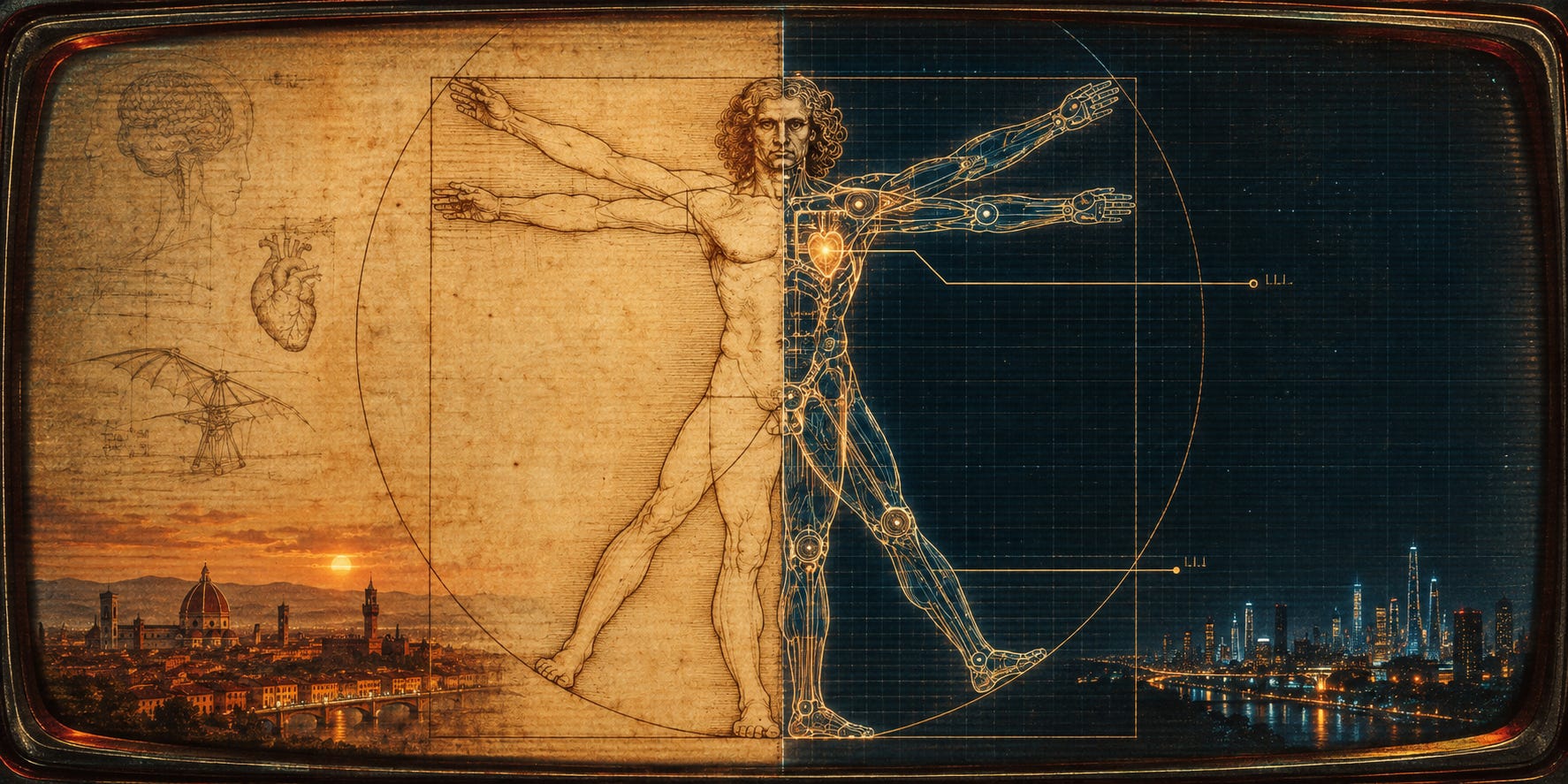
The Trusted Builder holds real things
The Trusted Builder holds real things because real things answer back2. A craft tells you you’re wrong every day (ask a surgeon, a machinist, or a violinist what the first ten years were for). A child, a classroom, a company, a town answer back too, but their standing is only as durable as you make it; the opening showed how power dissolves it. Every real holding offers a voice you can’t fire, the Builder keeps it unfireable on purpose, and the standard he keeps is one his grandchildren could understand.3
Holding creates duties, and I can testify to how easily the holder forgets them. I hold capital for a living. Every investment decides what receives years of other people’s effort: which cure gets attempted, which team spends its thirties on which problem. On a good day I feel that weight. On a normal day it’s a term sheet, and the beneficiaries are abstractions on a slide. The weight is easy to forget precisely because nobody bills you for forgetting it.
A teacher, a physician, a writer hold the same way, and trusteeship is the older word for it: power held for people who are counting on how you use it.4
The Trusted Builder uses AI without becoming its client
The machine can draft, calculate, simulate, translate, and run the first thousand passes. The Builder keeps enough skill to judge the result, enough independence to reject it, and enough responsibility to bear the consequence. AI is a power tool, not a pilot; delegation should extend your reach, and the authorship should stay yours.
The test is visible in small decisions: does the tutor make the student less dependent, does the leader create successors or followers?5 The Builder wants to win. The difference is that the win has to leave a larger field behind.
“How do we win together?” is the trustee’s North Star
The last essay’s method starts by writing a portrait, the North Star everything else points at. The trustee’s portrait compresses into a single question you can ask in any meeting: how do we win together? It only works in the first person: does my success leave you more capable, and does my victory leave you a meaningful place in the next round?6 The opening question is this one’s check: winning together decides whom the power serves, and the check is whether they’d agree. Good games have done it before: Florence routed status hunger through domes and workshops, and the Royal Society routed ego through public evidence. I’ve run the experiment: Folding@home only worked because millions of strangers lent their computers to a problem none of them owned, and every result they helped produce was published back to everyone.
Max, the fifteen-year-old from the first essay, is twenty-two now7, and the power is here: agents at his command, answerable to nobody, and nothing left that can make him come home. Ask him who can tell him he’s wrong; then ask the adults who raised him when they last let him tell them. The silence is usually mutual. He is watching which winners get admired and desperately needs to learn that it’s the one you can safely disagree with, not the one who blasts you when you do.
Back to the question this essay opened with. The voice that tells you you’re wrong can’t be something you authored or something you can dismiss, and the Builder has a standing answer because the reference is a relationship, not an emergency contact: with God, for the believer; with a mentor, a tradition, or people whose standing he protects, for everyone else. It’s kept the way any relationship is kept: regularly, and not only when something is needed. That’s the method’s calendar step, run on one person; the practice happens on the bad weeks too.
A trustee needs both conscience and audit
Good intentions are not governance; The Counterfeit Hero made that case for institutions, and it holds for a single life. Corner a persona, the defensive mask, and it has two moves: revise the story from inside, and control who gets to tell it from outside. Conscience answers the first move, audit the second. The Builder keeps score in ways that can prove the flattering story wrong8, and keeps people around who are independent enough to say so.
I can report how this feels from the inside, because these essays run the audit on me: the last essay’s step six, pointed straight at me. A reader who prices drugs for a living took apart two of my published examples of rent extraction. He was right, which stung, and my persona’s move was ready: defend the paragraph. I changed the paragraph instead. The correction is in the record, he is credited by name in that essay’s notes, and his standing to do it again is intact, which is the whole point. Who tells me I’m wrong that I can’t fire? A reader did, recently, and the essays are better for it.
The trilogy’s record check shows the price of the missing half: Gumbel counted Weimar’s political murders, the ministry itself confirmed the table, and nothing changed. Audit fails without a trustee at the other end of it.
And “together” can’t mean that the most conscientious person absorbs every cost, and it can’t end at expulsion either. Trust that breaks needs a staged road back, and the party holding the most power pays the first toll.9
It’s time to engineer the next Renaissance man. We have the technology.
The record shows the production run. In the 1420s the Gonzaga family gave a teacher named Vittorino da Feltre a villa in Mantua, and he renamed it the Casa Giocosa10, the Pleasant House. Princes and poor scholars sat in the same room, and the output, over two decades, was a generation of rulers, Federico da Montefeltro among them, the era’s working model of the humanist prince. Nobody legislated him into existence. The proof here is formation, not sainthood: the school produced the person the age had drawn, which is exactly the machinery on trial.
The school turned a portrait into practice, patrons bought the work time, the book gave the portrait language (Castiglione wrote it down the next century), and the aesthetic let people see the life before they read the philosophy. Nobody touched a soul directly; they built the room, and a generation formed inside it. The last essay’s method, run once at full scale. That is what it takes: a portrait worth imitating, the daily inquiry of “how do we win together,” an audit that can prove you wrong, and institutions built for the job.11 Those items are the method folded around one person: the portrait is step one, the daily question is its calendar, the audit is its confession, and an institution is all seven running at once.
Our version will arrive through many hands: a school where students use AI and still read hard books, a company that gives workers ownership and customers more agency, a patron who funds a teacher the market cannot yet price. The shared structure is enough: judgment, craft, obligation, place, and a relationship to something larger than the calculating self. I think that’s specific enough to begin, and open enough to improve.12
Yours starts smaller: pick one thing you already hold, put the people it affects in the room on a schedule, and let what changes because they spoke be visible.
Run Max forward once more, to twenty-five. What follows is a hope, not a report, and it has conditions: the first toll gets paid (in this story, the young one already paid it), the road back gets built from both ends, and the audit runs in both directions. Then he is at somebody’s table, teaching a younger person what he holds, and the work of repair is part of what he has to teach. Ask him then who can tell him he’s wrong, and he’ll have a name ready. That is the next Renaissance man, and we do not get him by accident.13
AI can make us more powerful than any humans before us. The Trusted Builder knows what that power is for. The ideal person after AI is not the person with the most power. It is the person we can trust to hold it.
That completes the portrait these three essays set out to draw. It’s also the first piece of the fourth pillar, and the piece the others exist to carry: four months ago I wrote that technology, knowledge, and capital had already arrived for this renaissance, and the portrait of a person hadn’t. Now it has. Drawing him took the whole series: a better game to put him in, a record of the counterfeits to check him against, and a method to form him. The school, the book, and the aesthetic are the rest of the year’s work.
But the portrait has a crack I haven’t dealt with: everything the Builder holds can be taken. The machine is coming for the work itself, and when the title goes, an older question is waiting underneath. The next essay is about who you are when the job is gone.
Third in The Person After AI series, after “AI Will Make Your Kids Powerful. But Who Will They Become?” and “How to Engineer a Soul.”
Acknowledgements: Thanks to Philip Soffer for asking me the opening question in the first place and igniting this line of thinking, to Ernest Morrow for his discussions that led to the initial ideas for this post, and to Greg Bowman and Lara Pande for their critical reading of this manuscript.
Builder is not founder. The term refers to a mode of participation in the world, not to entrepreneurship. Care, repair, teaching, stewardship, governance, creation, investment, and transmission all qualify when they increase human agency and leave durable capacity.
The “holds real things” portrait. The language develops the model person sketched in The Fourth Pillar: someone formed by craft, responsibility, place, mutual obligation, inherited tradition, and judgment with stakes. It is a normative portrait rather than a claim that one personality type is superior in every context. For the mechanism by which portraits shape conduct (prestige-biased imitation and exemplar effects), see the note on how portraits form people in the series’ first essay.
The Builder in myth. In mythic terms, the Builder is the hero after the return. The hero’s journey, the shape The Oldest Solution traced, ends when the gift comes home; the civilizational test begins the next morning: does the gift become a workshop, a school, a cure, a successor, or a new claim to tribute? There is an even older story, older than the hero’s journey, in which that next morning is the whole plot. Its protagonist does not leave a community to win something alone; she loses one, and the arc is the work of rebuilding it wider than it was (the shape has nothing to do with the sex of the person walking it). Inanna descends that way, and so, centuries later and next door, do Isis and Demeter. That is the second shape, and the Builder is what it looks like when someone runs it on purpose. It is also step two of the last essay’s method: people carried this portrait in stories for thousands of years before anyone wrote the steps down.
Trusteeship. A trustee holds authority or assets for beneficiaries and accepts duties governing their use. Aaron M. Renn’s “The Public Intellectuals America Needs” (2026) applies that idea to individuals who inherit responsibilities once carried by trusted institutions. This essay generalizes the ethic to any person holding consequential capability. It does not suggest that founders, teachers, physicians, investors, or writers have identical legal duties; it argues that each role carries beneficiaries whose interests cannot be reduced to the holder’s private preference.
The small-decisions battery. The full battery of these questions is in We Need a Better Game; it is one test asked in different rooms.
The wide mode. Winning together requires being able to feel another person’s flourishing as part of the whole, not a subtraction from your own. The Oldest Solution called that the wide mode. A believer may call it listening to God; a skeptic, conscience. Either way, the Builder knows how to stop optimizing long enough to ask whether the objective deserves to exist.
Max. The name is invented and identifying details are changed; the person, and every event involving him in these essays, is real. The twenty-five-year-old in the closing section is not a report. He is a hope.
Conscience and audit. The claim that a trustee needs external correction as well as good intent is grounded in the same asymmetry developed in The Counterfeit Hero. Grijalva and colleagues’ leadership meta-analysis found that narcissism can aid leadership emergence without improving overall effectiveness; Bandura’s moral-disengagement work explains how sincere conviction can accompany harmful conduct; and Leary and colleagues’ intellectual-humility studies concern recognition that one’s beliefs may be wrong. The essay translates those findings into a governance principle by requiring disconfirming measures and people with standing to disagree. The two-moves framing follows the person and persona distinction developed in the series’ second essay. The question is self-reported, which is why the answer starts the inquiry rather than ending it: the evidence is who overruled them, what changed, and whether that person retained their standing.
The road back. A road back is not an entitlement to the same position of trust. What that road looks like is a later essay’s job.
Formation, and the Casa Giocosa. The book, school, aesthetic, ritual, apprenticeship, community, and patron are recurring institutions through which historical ideals became imitable. Vittorino da Feltre ran the Casa Giocosa in Mantua from 1423 until his death in 1446 under Gonzaga patronage, teaching princes and poor scholars together, the poor without fee, with a curriculum joining classical study and physical training; his pupils included Ludovico Gonzaga and Federico da Montefeltro. Castiglione’s Cortegiano (1528) wrote the portrait such schools trained toward. The essay does not claim that Renaissance institutions were inclusive, peaceful, or morally complete. Federico’s own record as a holder of trust is contested: a decoded letter published by Marcello Simonetta ties him to the Pazzi conspiracy against the Medici. The claim in the text is about the machinery of formation, not the sainthood of its outputs.
The three-to-one rule. Rudolf Steiner, How to Know Higher Worlds (CW 10, serialized 1904-05): “For every one step that you take in the pursuit of higher knowledge, take three steps in the perfection of your own character,” as the rule runs in the standard English rendering. The rule is cited as a formation standard, not as an endorsement of anthroposophy, whose later history is a case study in the failure this essay’s audit requirement exists to prevent: a formation system that produced schools, clinics and communities while its founder’s word remained the evidence no member could contradict. Our century kept the one and dropped the three.
What would count against this. The essay demands measures capable of disproving a flattering self-portrait, so it should name its own. The Builder portrait earns its place only if institutions that form people on it show measurable differences against comparable institutions that do not: in whether students and customers gain agency, in whether leaders produce successors, in whether trust extended is honored. If those differences fail to appear, the portrait is decoration and should be revised.
The technology line. The cadence of the final heading is the opening narration of The Six Million Dollar Man (1974): “Gentlemen, we can rebuild him. We have the technology.” The show rebuilt a broken man to his old spec. This project proposes something harder and better: not a rebuild, and not one man.
Looks like the money is getting sobered.
Where have I heard that before??
https://www.wsj.com/tech/ai/openai-raises-less-than-half-of-30-billion-target-in-latest-round-91aecdc5?st=uprFGD&reflink=article_copyURL_share
Vijay, one safeguard worth examining is whether disagreement has consequences for the person offering it. It’s easy to point to an advisory group or trusted colleagues as evidence that a leader welcomes correction. But I would look at what happened the last time someone challenged an important decision. Did their influence remain intact afterward? A leader’s response to being challenged tells us far more than the number of people invited to offer advice.