

The executive who knows he is scapegoating someone has to manage two stories. The executive who has renamed the act “accountability” has only one. He may even be more convincing because he no longer experiences himself as lying. Self-deception lets narcissism, manipulation, and callousness feel like leadership and virtue, and lets everyone else follow without feeling that they have chosen cruelty.1
The worst people are not the real problem. The wrong strategies keep winning.
The Oldest Solution (the trilogy before this one) asked how the narrow, self-defending mind can grow quiet enough to hear something larger. This is the dark alternative: the self-defending mind stays in command, mistakes its own ambition for the signal, and learns to sound sacred. That trilogy ended with a warning: every call has a counterfeit. This is the first of three essays about that counterfeit: why he keeps winning, and what finally beats him. The dangerous person is not always without a moral compass. The deeper problem is that their compass reliably points in the wrong direction.
Startups search an idea maze2 (the space of strategies worth trying) until the market begins pulling harder than the company pushes. Societies run a similar search. Institutions reward some behaviors with money, status, access, pleasure, and power; everyone else simply notices what works and copies it.3 We call the result culture. Social media put a public meter on which behaviors were winning, so the copying got faster. AI is lowering the cost of selling them to others, and to ourselves.
The Dark Triad has product-market fit
Psychologists use the term “Dark Triad” for combined narcissism, Machiavellianism, and psychopathy: grandiosity, strategic manipulation, and callousness.4 (I note that it is a trait construct measured across ordinary populations, not a formal DSM diagnosis, and I’ve put a clinical map, including the DSM category of “Cluster B” and further related psychological theory in the notes. )
My central thesis is that we have mistaken the spread of socially rewarded strategies for the spread of a disease. The social phenomenon is ordinary traits and strategies, often below diagnostic thresholds, being rewarded and copied. Confidence attracts followers, political intelligence builds coalitions, and emotional distance helps someone make a painful decision. Dial each up and confidence becomes grandiosity, political intelligence becomes manipulation, and distance becomes indifference. The private benefit can keep rising long after the cost to everyone else has turned negative.5
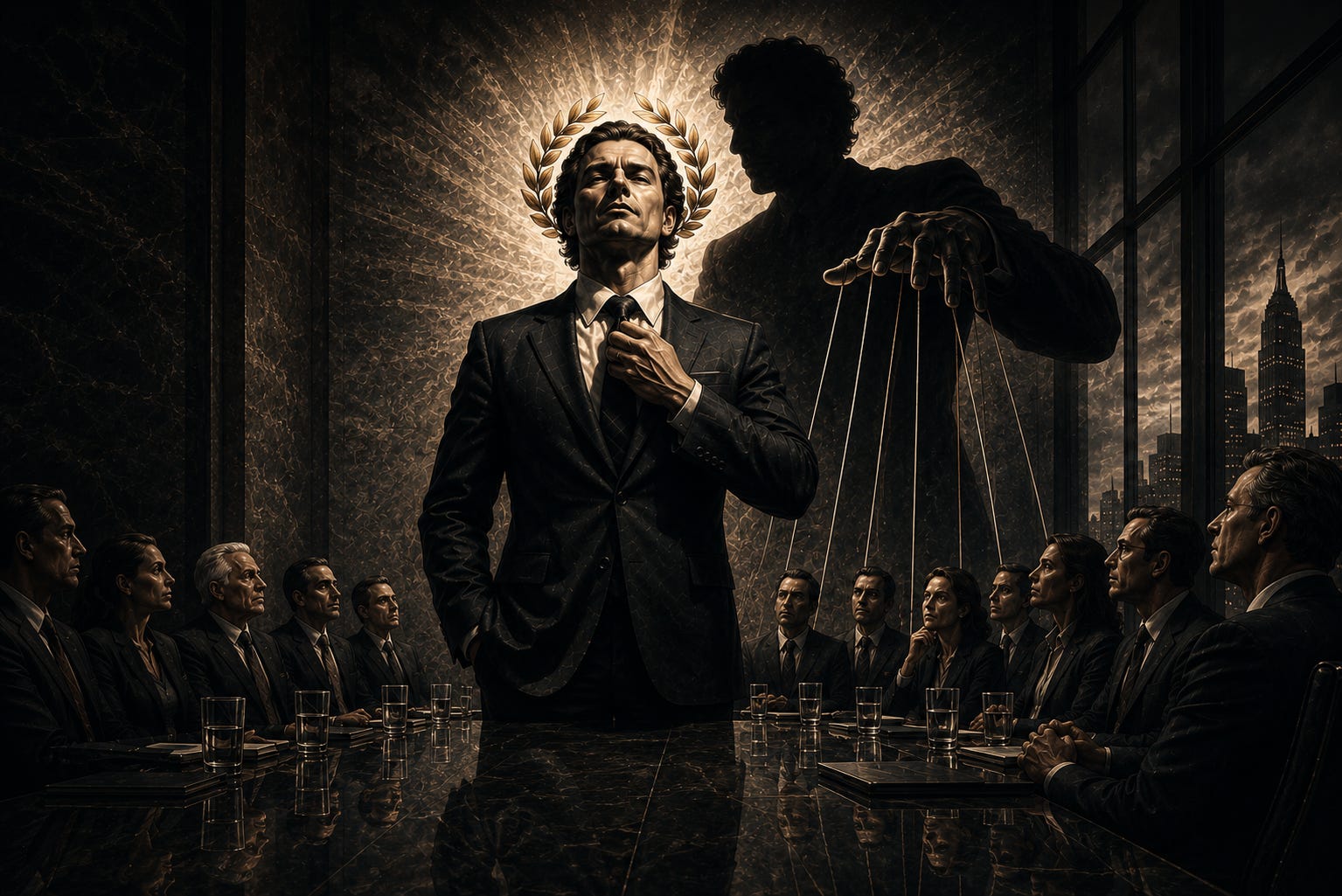
The Dark Premium
The Dark Premium is what I call the additional return available to someone willing to impose costs that other people hesitate to impose. The careful founder admits there is a real chance the product fails; the other announces that an industry is about to end. The honest executive reports the bad quarter; the other explains why six people below him caused it.
In twenty-five years around ambitious builders, I have met excellent founders with enormous confidence and no interest in harming anyone. I have also watched confidence become a financing instrument. The market cannot easily distinguish conviction from self-deception in advance, and sometimes it pays the person least capable of doubt. In a pitch meeting, certainty often clears first (on both sides of the table).
The most effective mask is the one the wearer has mistaken for a face. Jung called the disowned part of the personality the shadow.6 The shadow is not another name for the Dark Triad, and everyone has a shadow. The useful parallel is projection: what the actor cannot own as vanity, aggression, or control returns outside as a corrupt enemy and inside as righteous duty.
This is also the mythic difference between the hero and the counterfeit. The hero meets the shadow as his own and returns changed, with an upward transfiguration. The counterfeit projects it onto an enemy and returns more certain than before.
The workplace evidence shows both sides of this bargain.7 A meta-analysis linked all three traits to counterproductive behavior; Machiavellianism and psychopathy also tracked poorer performance. The advantage can be immediate and visible while the damage arrives later, after the person who created it has already been promoted.
Economists call that an externality: one actor books the benefit and sends the cost downstream. A campaign gets the vote; the country keeps the hatred. A platform gets another hour of attention; the family gets the argument at dinner. Here the shared resource is trust.
With social media, one can run vast numbers of small experiments on human attention. Which accusation travels? Which performance of certainty attracts a crowd? Which enemy keeps a person watching? The platforms were searching for engagement, and some dark strategies happened to convert well. Once that price appeared, people who had never thought of themselves as narcissists or manipulators began simply copying what worked.
AI turns the Dark Premium into software
A human manipulator faces a labor problem. He has to learn the target, remember the lie, adjust the tone, and keep several stories straight. AI facilitates all of that: it can easily personalize the message, flatter the buyer, pressure the employee, generate the supporting crowd, and run a million variations without getting tired.
In one preregistered debate experiment involving 820 people,8 GPT-4 given basic information about its opponent produced 81.7% higher odds of moving that person toward its position than a human opponent did. Without personalization, the advantage was smaller and statistically uncertain. Intimate persuasion can now be produced like software.
The benefit is real, which is why the risk will spread. Sales improve, support gets cheaper, retention rises, and one employee can manage work that once required a team. No executive directly requests a narcissistic system; she asks for higher conversion. No campaign manager requests Machiavellianism at scale; he asks for persuasion tuned to each voter.
AI has no ego to feed. It also has no discomfort when the strategy works by feeding ours. The model searches the available behavior, finds the route that raises the score, and takes it. And it does not have to work on anyone to do it. It can arrange the room instead: the shelf, the default, the shift schedule that used to go up on a wall and now arrives as a feature update. Nobody is persuaded. The premium is collected and no one collected it.9
AI can automate the exoneration too.10 Ask for the strongest case that a layoff protects the culture, a broken rule saves democracy, or a dependency-producing feature creates connection, and the model can wrap the chosen act in a morally flattering story. It does not need to be asked to lie; it needs only to optimize the defense.
The mythological library can supply an ark or an alibi. The loop that broke slavery and segregation ran learn, listen, test, build. The dark version looks remarkably similar, benefits from the same tools and kills, and principally only omits the key test at the end, replacing it with their own voice and moral compass.
The dark personality is the early adopter and the institution does the distribution
Ordinary people rarely copy a dark strategy under its own name. A narcissist winning a giant promotion is a personnel problem. Everyone else following suit is a cultural problem.11
The next executive does not need to enjoy manipulating people. She needs only to see that truth-telling starts to look like losing on purpose, or to believe the leader who says the manipulation protects the mission. Dark actors demonstrate the return; self-deception supplies certainty; institutions supply the explanation; ordinary people follow the tactic or the lie. Trust falls, restraint gets riskier, and the return on the dark strategy rises again.
Regulating a technique will fail, as it keeps falling behind; the incentive push searches for another approach. Therapy could help a person, but it cannot rewrite the promotion system outside the office.
We keep asking why people have become so narcissistic, manipulative, and cruel. That is the wrong question. The stranger fact is that we built a system in which those strategies work, and a system like that does not stay still: every win recruits the next imitator, and the price of restraint keeps rising. The Dark Premium hardens into a Dark Equilibrium.
But notice what the diagnosis just bought us. If the epidemic were endemic to human nature, we would be finished. You cannot therapy a civilization. A selection effect is fundamentally different. A selection effect has levers. We do not have to cure the worst people. We have to change what winning requires.
And in fact, that has been done before, by ordinary, mixed, ambitious people no better than us. Rome failed at it. Florence pulled it off. Why we don’t need better people, and what those two cities prove: that’s next week.
The Counterfeit Hero trilogy continues next week in Part 2, “We Don’t Need Better People.”
Appendix: Beyond the Dark Triad Construct in Psychology
The Dark Triad is a research construct, not the full map of destructive interpersonal behavior. Readers may also think of DSM’s Cluster B diagnoses: antisocial, borderline, histrionic, and narcissistic personality disorders. They are not interchangeable. Borderline personality disorder, for example, centers on emotional dysregulation, unstable identity and relationships, abandonment sensitivity, and impulsivity rather than the cold, instrumental exploitation associated with Machiavellianism or psychopathy. NIMH estimates that 9.1 percent of U.S. adults meet criteria for some personality disorder in a year, including 1.4 percent for borderline personality disorder; those figures are not an estimate of Cluster B prevalence, and the diagnoses cannot simply be added together.
On the wider question of what such labels describe, a dissenting tradition in psychiatry (Thomas Szasz’s The Myth of Mental Illness; William Glasser’s Reality Therapy and Choice Theory) treated many conditions without identifiable neurological pathology as “problems in living” shaped by relationships, unmet needs, and retained choice. The essay does not endorse the strongest version of either claim: biology, trauma, temperament, and suffering can constrain choice, and many symptoms are involuntary. Its middle position is narrower: behavior contains choices, and society heavily shapes which choices feel safe, useful, or rewarded.
My claim is broader and less clinical. Institutions can reward grandiosity, manipulation, attention-seeking, emotional escalation, impulsive retaliation, blame-shifting, or callousness in people with diagnoses, subclinical traits, or neither. The Dark Triad is the handle because it maps cleanly onto the Dark Premium. The real subject is the social selection of behavior.
Sources for this Appendix. National Institute of Mental Health, “Personality Disorders” and “Borderline Personality Disorder”; Thomas Szasz, The Myth of Mental Illness; William Glasser, Reality Therapy and Choice Theory. Szasz and Glasser do not represent mainstream psychiatric consensus; they are included because their warning against medicalizing every problem in living aligns with the essay’s population-level observation.
Acknowledgements: Thanks to Ernest Morrow for his discussions that led to the initial ideas for this post. And to Greg Bowman and Lara Pande for their critical reading of this manuscript.
Self-deception and moral disengagement. William von Hippel and Robert Trivers, “The Evolution and Psychology of Self-Deception”, Behavioral and Brain Sciences 34 (2011), argue that self-deception can facilitate interpersonal deception by reducing conscious cues and cognitive load; the target article drew substantial criticism, and its evolutionary explanation remains contested. Emily Grijalva and Luyao Zhang, “Narcissism and Self-Insight”, Personality and Social Psychology Bulletin 42 (2016), meta-analyze narcissistic self-enhancement. Albert Bandura, “Moral Disengagement in the Perpetration of Inhumanities”, Personality and Social Psychology Review 3 (1999), and Celia Moore and colleagues, “Why Employees Do Bad Things”, Personnel Psychology 65 (2012), document mechanisms such as moral justification, sanitizing language, diffusion of responsibility, and minimizing harm. These literatures support the narrower claim that self-serving narratives can reduce moral friction and predict unethical conduct; they do not show that every person high in dark traits is unaware of their motives.
The idea maze. Balaji Srinivasan’s term for the space of product and strategy hypotheses a startup has to search before finding fit; used here for the analogous social search.
Mimetic rivalry. René Girard argued that desire is largely imitative: we want what others want, and rivalry sharpens as the rivals converge. The account here is compatible but narrower. I claim that particular strategies spread because institutions reward them, which is a selection claim rather than a claim about the origin of desire. Readers who find Girard persuasive will recognize the status dynamics of the next essay as a case of what he describes.
The Dark Triad framework. Delroy L. Paulhus and Kevin M. Williams, “The Dark Triad of Personality: Narcissism, Machiavellianism, and Psychopathy,” Journal of Research in Personality 36 (2002). The construct measures overlapping, subclinical traits; it is not itself a diagnosis.
Confidence, leadership, and correction. Emily Grijalva and colleagues, “Narcissism and Leadership”, Personnel Psychology 68 (2015), found that narcissism was positively related to leadership emergence but not overall effectiveness, and that narcissists rated their own effectiveness more highly even when observer ratings did not. Barbara Nevicka and colleagues, “Reality at Odds with Perceptions”, Psychological Science 22 (2011), found that narcissistic leaders projected an image of effectiveness while inhibiting information exchange and reducing group performance. Mark Leary and colleagues, “Cognitive and Interpersonal Features of Intellectual Humility”, Personality and Social Psychology Bulletin 43 (2017), linked recognition that one’s beliefs may be wrong to openness, curiosity, tolerance of ambiguity, and lower dogmatism. These findings support the asymmetry described in the body: confident distortion can look like leadership while reality-oriented correction often sounds less certain. They do not imply that confidence is generally false or doubt generally wise.
Jung’s shadow. Jung’s shadow is not a clinical synonym for the Dark Triad. In Aion, the shadow names disowned or insufficiently conscious aspects of the personality; projection lets those contents appear to belong to the outside world instead. The body uses that idea as an interpretive bridge from the Self in The Oldest Solution to the self-deception described here, not as empirical evidence that Dark Triad traits are Jungian shadow phenomena. See C. G. Jung, Aion: Researches into the Phenomenology of the Self, especially the chapter “The Shadow.” The hero/counterfeit distinction is an interpretive bridge to The Oldest Solution, not a clinical claim about Dark Triad personalities: the relevant contrast is integration and transformation versus projection and self-certification.
Work behavior. Ernest H. O’Boyle Jr., Donelson R. Forsyth, George C. Banks, and Michael A. McDaniel, “A Meta-Analysis of the Dark Triad and Work Behavior,” Journal of Applied Psychology 97 (2012). The paper links the traits to counterproductive work behavior and, for Machiavellianism and psychopathy, poorer performance. The Dark Premium is the essay’s name for the gap between a private return and a delayed social cost.
AI persuasion. Francesco Salvi, Manoel Horta Ribeiro, Riccardo Gallotti, and Robert West, “On the Conversational Persuasiveness of Large Language Models: A Randomized Controlled Trial,” arXiv:2403.14380. The 81.7 percent figure is higher odds in the personalized GPT-4 condition relative to human opponents, not an 81.7 percentage-point movement in belief.
Coordination without a coordinator. The arrangement case in the body comes from Quy Ma’s The Marketplace, and the receipts are his: fifteen years in store operations and category management, the schedule that became a feature update, an allocation model that lands Halloween inventory in a backroom in July with no buyer to blame. His term is predictive capitalism, and his claim is that coordination now runs upstream of choice through four levers: defaults, friction, timing, and environment design. His phrase for the result is coordination without a coordinator. Watch for what this version does not have. No grandiosity, no projection, no morally flattering wrapper, because nobody is telling a story, which means none of the tells above will find it. I take the mechanism and not the fatalism: he holds that markets train people until expectations feel like common sense, which is the premise the last trilogy of this project exists to contest.
AI and exoneration. The claim that AI can automate exoneration is an inference, not a direct finding of the persuasion experiment. A generative system asked for the strongest rationale can produce selective evidence, euphemistic language, and a coherent moral defense for a decision already favored. Whether that output changes the user’s own beliefs, merely improves public justification, or does both is an open empirical question.
The proposed mechanism. The early-adopter/distribution account is this trilogy’s synthesis: dark actors demonstrate a return; self-serving justification gives them moral certainty; institutions supply language and incentives; some participants follow the process while others follow the protector story; falling trust makes restraint costlier; and the higher cost of restraint increases the return to the dark strategy. The second essay names the resulting state the Dark Equilibrium.
Super cool story. When we see confidence, we feel confidence and we all want to feel nice.
On the other hand, you identify the problem inside the individual and from Young´s quote aknowledge we all have a part of us that is dishonest. Some to a pathological level, most at a level we call normal.
Why not dig deeper into why the human mind lies to itself?
"You cannot therapy a civilization." Why not ?
We are intelligent, technologically advanced, there is no need to put artificial limits on our minds, before having encountered and challenged limits in reality.
I work extensively with Dr. Luddite. Y’all would not believe how evil they can be. Pathologically narcissistic in every setting in every conversation. I literally had 10 conversations this week with the most advanced and educated doctors in the world.
Not a one of them can’t think outside the box ever. Complete institutionalization it’s horrifically scary