

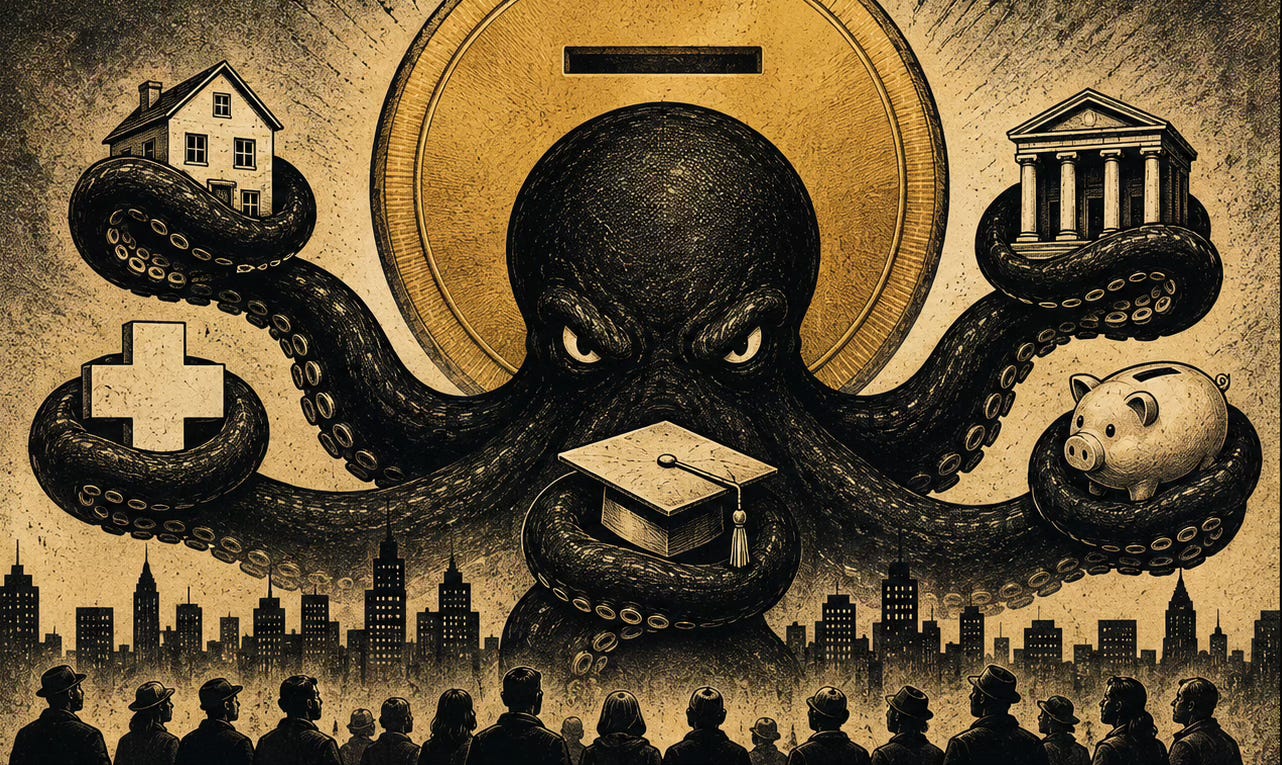
The Renaissance Papers · Series II, part 2. Previously: part one argued that cheap machine labor can move productive power toward individuals. But ownership means little if every road from production to the customer is tolled. This essay names the tollbooths. The map is here.
The anger at capitalism is aimed at something real. And it’s our job to fix it. That's not a claim thrown around frequently in venture capital. And I just wrote an essay retiring Marx—but stay with me. The mistake in all that anger is the target. Much of what people hate about capitalism isn't the building of businesses; it's five specific rackets we keep producing, all five running the same play.
Economists have a name for this pattern: rent seeking — income you collect because you control a chokepoint, not because you built anything. A tollbooth on a road someone else paved. The booths have gone up everhwere: on the land under your apartment, at the hospital door, inside the pill bottle, across the only bridge out of town.
Here’s how AI can radically change this game.
What people really hate: five rackets
Racket 1: the chokepoints themselves. Housing is the obvious case — the rent in rent seeking is literal. Austin recently offered the test case: permit a building boom, and rents promptly fell about 7% in a year. But the more pure modern example is healthcare complexity. Every layer of billing codes and prior authorizations creates a niche where someone charges for passage. By one widely cited count, since the mid-1970s, the number of American physicians grew about 150%; administrators, something like 3,000%. Nobody got healthier because of the second number.
Racket 2: heads I win, tails you lose. Privatize the gains, socialize the losses. The S&L crisis dropped roughly $124 billion of bank losses on taxpayers, and 2008 ran the same play again. A factory that pollutes a river books the profit and mails the cleanup bill to the public. Economists call the missing charge an externality — a cost you create but don’t pay. People on the short end of it call it a rigged system.
Racket 3: markets that feed on the problem. When revenue rises with the persistence of the problem rather than its resolution, that system is profiting from its problem. I call it the Sickcare Test. America spent $4.9 trillion on healthcare in 2023, nearly a fifth of GDP, much of it managing disease rather than ending it. In recurring-revenue sickcare, a patient cured is a customer lost. When Gilead’s Sovaldi started actually curing hepatitis C (around 95% of patients: treated, done, gone), a Goldman Sachs analyst asked, “Is curing patients a sustainable business model?”
Arms dealers pass it: more war, more revenue. Parts of higher ed pass it: $1.7 trillion in student debt, much of it buying credentials whose main function is to require the next credential. Corrections passes it too: well over $100 billion a year buys a 68% three-year rearrest rate, and the system’s budgets survive the failure. California’s homelessness system shows the same warning sign: billions spent, homelessness up, and the state unable to say consistently what the money bought.
In my mind, this is the big one in terms of its broad proliferation and ease of establishment, when “helping” be used to disguise rent seeking.
(Before the complaints mount: yes, profits fund R&D, and inventing cures for profit is exactly what we want more of. The build deserves a return. The racket begins when protection outlives the risk that justified it.)
Racket 4: profit on the inelastic. Inelastic is the econ-term for demand that barely moves when prices rise — insulin, an EpiPen, water after a hurricane. When necessity meets market power, price stops measuring preference and starts measuring captivity. Banting and his collaborators sold the insulin patent for $1 in 1923 because they thought it belonged to the world; by the early 2020s, vials costing single-digit dollars to make listed near $300. The public’s fury at this is economically literate. Pricing power over a captive buyer is the same booth again: this time between you and your own bloodstream.
Racket 5: the quiet rewrite of the deal. In 1980, roughly four in ten private-sector workers had a pension — a promise someone else had to keep. Today it’s about one in ten, and the replacement (the 401k) moved ownership and market risk onto the worker. Maybe that trade was even necessary — portability matters when nobody stays thirty years at one company. But the trade was never priced honestly (”the professions can’t make the pension math work, so you have a go at it yourself”) and they can feel the difference even when they can’t articulate its cause. Ownership without a floor is not the same as freedom.
Five rackets, one root: money made without a matching improvement.
The mechanisms differ, but the move is the same: collect where the customer cannot meaningfully say no. The strongest booths still sell something real. Often they sell back, at retail, what a working commons once supplied: the safe street priced into the rent, the trusted school as private tuition, the neighbor who used to watch your kid as an additional expense. That’s why the metrics can keep improving while life feels worse. And a tollbooth that shares enough of its take recruits its own defenders, not just customers (see last endnote).
The opposite of a racket isn’t a nonprofit. It’s a business that gets paid when something actually improves — and bears the costs when it doesn’t.
Notice what’s not on the list. The builders who sell people things they freely want — sneakers, phones, the morning coffee (albeit they collect the occasional boycott at their racket moments, ie the sweatshop or the walled garden). The problems run show up in the hospital bill, the tuition letter, the rent check. Jonas Salk gave the polio vaccine away and asked, “Could you patent the sun?” The public’s diagnosis that something is wrong is often better than the pundits’. They’ve just been told its name is capitalism.
So why is it still growing? We’ve been operating for forty years, one racket at a time. Cap insulin, and the rent moves to the PBM (pharmacy middlemen — three of them touch 80% of American prescriptions). Regulate the banks, and the risk migrates somewhere darker. Audit the colleges, and the credential inflates. Mancur Olson explained why half a century ago; a small group with concentrated winnings out-organizes a large public with diffuse losses, every time. The racket will always care more about its billions than you care about your extra $40 a month.
Forty years of losing was never about will. The scope was wrong: five small wars where there should have been one big one. Piecemeal reform regulates the booth. Socialism too often gives it a new flag. Where technology makes it possible, the builder’s answer is to dissolve it.
What AI hits first
AI is about to flip the board, and not evenly, because the five rackets are not equally mortal. Here’s the order they become vulnerable. Rents made of information go first: the PBM’s spread and the 401k’s fee maze survive only as long as auditing them costs more than paying them, and an agent that audits for free ends the information advantage. Complexity rents go next, with a catch — right now it’s the insurers buying the prior-auth AI, not the patients. Watch whose agent the machine is; that single fact tells you who keeps the rent. Credential rents become vulnerable more slowly, by legitimacy collapse rather than substitution: nobody needs the learning gate once learning is free, but the credential survives as a trust signal — and because the law still says you need it.
Externality rackets subside as detection gets cheap (a satellite can now read a methane leak off a single well), though enforcement stays political. And the oldest rents — land, patented essentials, the physically scarce — barely change. Their scarcity is physical or legal; the rent is defended by law. So here’s the tell for the next decade: lobbying budgets will spike in proportion to AI-vulnerability, because a racket that can’t survive the market retreats into the statute book. This paragraph is a forecast; grade it in 2031. And you don’t have to spectate: root for the agents, or even better, build them.
The rents AI can’t kill are the ones only a movement can. The extermely counter intuituve, paradoxical answer is that we haven’t solved the problem because we haven’t made it big enough. How five losing reforms become one big movement — Renaissance-big — is essay three.
Notes
The physician-versus-administrator figures (~150% vs ~3,000% growth since the mid-1970s) trace to Himmelstein and Woolhandler’s compilations; definitions of “administrator” vary and the base year flatters the ratio — the direction survives every definition on offer.
The S&L bill is the FDIC’s own post-mortem: roughly $124 billion of the cleanup landed on taxpayers.
U.S. healthcare spending reached $4.9 trillion in 2023, according to the Centers for Medicare & Medicaid Services’ National Health Expenditure report.
The Goldman Sachs question is verbatim from an April 2018 client note, “The Genome Revolution,” by analyst Salveen Richter. Goldman confirmed the report’s contents to Ars Technica ; the note used Gilead’s hepatitis-C franchise as its case study. California’s State Auditor reported that the state allocated nearly $24 billion to homelessness and housing affordability from fiscal years 2018–19 through 2022–23, while lacking consistent statewide information on program costs and outcomes. The audit also reported more than 180,000 Californians experiencing homelessness in 2023, up 53% from 2013.
The current direct-spending estimate for corrections — prisons, jails, juvenile facilities, probation, and parole — is roughly $116 billion a year. The 68% figure is the Bureau of Justice Statistics’ three-year rearrest rate for state prisoners released in 2005.
The insulin patent rights were transferred to the University of Toronto for one dollar apiece . “Near $300” refers to major manufacturers’ list prices in the early 2020s; for example, Humalog listed at $274.70 before Lilly’s major price reduction took effect in 2023.
The PBM figure: three firms (CVS Caremark, Express Scripts, Optum Rx) process roughly 80% of American prescription claims; the share moves a little year to year, the concentration doesn’t.
Pensions: defined-benefit coverage of private-sector workers ran about 38% in 1980 and sits near one in ten today (BLS and EBRI series — definitions of “coverage” vary, and the cliff is in every one of them).
Johann Kurtz,“Young adults are poor despite every metric which suggests otherwise” , July 14, 2026, argues that when social capital and common goods decay, families must buy private replacements (safe neighborhoods, trusted schools, childcare) at retail. Quinn Slobodian, “Digital Bandung”, The Ideas Letter 64, May 14, 2026, sharpens the other half: durable systems of extraction survive not by taking alone, but by delivering real convenience, pleasure, employment, and asset gains through networks of intermediaries and beneficiaries.
Acknowledgements
Thanks to Lara Pande for her critical reading of this manuscript.
@vijay pande A key reason people intuitively get was going on is because they live in the real economy not the financial one. One of the most insightful article about this is “The Velocity Problem” by @quy ma